The ¥50 Street Food Tour I Take Every Foreign Friend On
The ¥50 Street Food Tour I Take Every Foreign Friend On
Quick answer: You can eat your way through Chengdu's best street food for about ¥50 (roughly US$7) without a tour group. The secret locals use is ordering by "liang" (一两 ≈ 50g) so you sample five small dishes instead of filling up on one. Expect dan dan mian, chao shou wontons in chili oil, sweet water noodles, and a cold drink across a 90-minute walk.
My cousin flew in from Frankfurt last spring with two rules: no tour groups, no Michelin lists, and please don't put him in another hotpot chain with laminated English menus. So I took him on the walk I take all my foreign friends on — a Chengdu street food tour that costs ¥50 per person, lasts about two hours, and hits four to five dishes that define the city. He ate more than me. We had change left over for mango tea.
This isn't the ¥300 "food tasting tour" sold on booking sites. This is how my family eats when we want lunch out.
What this guide covers
The real 2026 prices for a ¥50 Chengdu street food tour: exact dishes, exact stalls, exact neighborhood
A step-by-step walking route between Kuanzhai Alley (Wide and Narrow Alley) and the surrounding local blocks
How to order when you don't speak Mandarin — point, show a photo, and let Alipay do the talking
Five dishes every Chengdu street food tour has to hit, with what to say if the stall person asks a question
Where to sit, where to stand, and why the ¥50 budget is not a gimmick
An optional ¥50 extension for dessert, and a separate ¥50 dinner route using the same logic
FAQ on spice levels, timing, and whether this Chengdu street food tour works as a solo traveler
No pre-booking, no tickets, no tour guide collecting kickbacks. Just walking, eating, and paying in coins of yuan.
Heading to China soon?
Take every guide offline — translation, payments, maps, and emergency help in one free app.
Why ¥50 is the right budget for a Chengdu street food tour
Chengdu is the only Chinese megacity where the ¥50 lunch budget is still, in 2026, enough to eat like a king. Beijing will charge you ¥50 for one bowl of noodles. Shanghai will charge you ¥50 for a coffee. Chengdu, if you know where to walk, still does four to five small plates for ¥50 and you'll push away half-finished because your tongue is on fire.
Here's the price benchmark I use for any Chengdu street food tour:
Dish | 2026 price | Portion |
|---|---|---|
Dan dan mian (担担面) | ¥8 | Small bowl, perfect appetizer size |
Sichuan wontons in red chili oil (红油抄手) | ¥12 | 8–10 wontons |
Mapo tofu small claypot (麻婆豆腐) | ¥15 | Small portion with rice |
Sichuan cold noodles (凉面) | ¥10 | Take-away portion |
Fresh fruit tea or sugar cane juice | ¥5 | Sealed cup |
Total | ¥50 | 4–5 dishes |
That's the math. You don't need a food tour company to recalculate it for ¥380. You just need to walk into the right block.
The walking route: a real ¥50 Chengdu street food tour
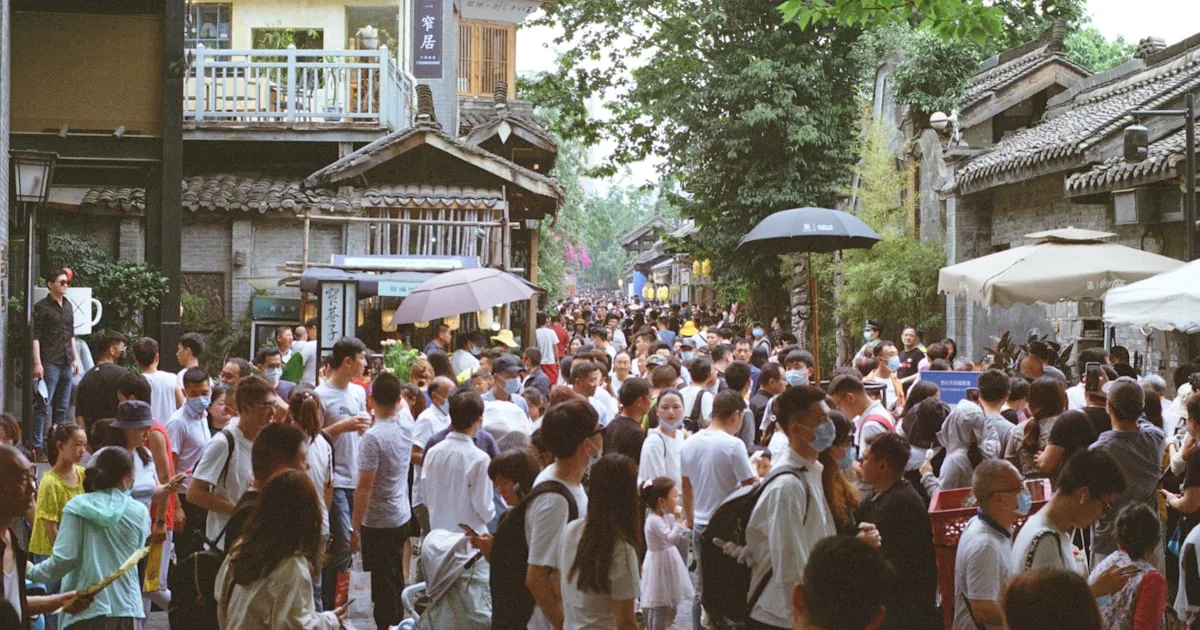
Start at Kuanzhai Alley (宽窄巷子) metro exit — Line 4, People's Park Station (人民公园) is one stop south and walkable in 8 minutes. Kuanzhai itself is a tourist alley and the food inside is marked up 50–100%, so we use it only as a landmark. The plan: walk through it, cross out of it, and eat on the surrounding streets.
Stop 1: Dan dan mian, ¥8
From Kuanzhai Alley's north exit, turn left onto Changshun Shangjie. After 200m you'll see a row of small noodle shops — look for the one with a handwritten yellow sign that says 担担面 (dan dan mian) and a chef-auntie tossing noodles over a wok of fragrant chili oil.
The bowl is small. That's the point. Dan dan mian is street food, not a meal. You get hand-pulled wheat noodles, ground pork, chopped sui mi ya cai (pickled mustard greens), roasted peanuts, chili oil, and sesame paste. You stir it yourself — all the flavor sits at the bottom.
How to order. Hold up one finger and say "yi wan dan dan mian" (一碗担担面, "one bowl dan dan mian"). Or point at the photo. The auntie will probably say "la ma?" (辣吗) — "spicy?" Nod once. If you can't eat chili at all, say "bu yao la" (不要辣, "no chili") and she'll make a mild version. Pay ¥8 via Alipay QR at the counter.
Eat standing or on the plastic stool outside. This is the warmup for your tongue.
Stop 2: Sichuan wontons in chili oil, ¥12
Walk 400m further west onto Kangzhuang Jie. Look for a small shop called 小名堂 or any red-signed place with 抄手 (chao shou) in the name. "Chao shou" means Sichuan wonton — literally "crossed arms," because of the shape.
Order "hong you chao shou, xiao wan" (红油抄手,小碗, "red oil wontons, small bowl"). ¥12 gets you 8–10 meat-filled wontons floating in chili oil with vinegar, sugar, garlic, and sesame. The sauce is sweet, spicy, sour, and savory all at once — it's one of those dishes that ruins your expectations of dumpling sauce forever.
If you want a lighter version, ask for "qing tang" (清汤, "clear broth") — chao shou in plain pork broth with scallions. Same ¥12. Some people do one of each.
Stop 3: Mapo tofu claypot, ¥15
Now walk back east and cross into Zhitai Jie. This is the street where Chengdu locals actually live, not the cosplay-Tang-dynasty street inside Kuanzhai. You're looking for any rice-plate shop (快餐店 or 盒饭) that has a big photo of bubbling tofu on the wall.
"Mapo doufu xiao guo" (麻婆豆腐小锅, "mapo tofu small claypot"). ¥15 gets you a small clay pot of silky tofu cubes in a thick, numbing-spicy sauce of doubanjiang (fermented bean paste), ground beef (traditionally, sometimes pork), fermented black beans, and a heavy pour of Sichuan peppercorn oil. Comes with a small bowl of steamed rice.
The word "ma" in mapo is the tongue-numbing sensation from Sichuan peppercorns. It's not heat. It's electricity. First-timers often think something is wrong with their mouth for the first 30 seconds. It's supposed to feel like that.
If you want it milder, say "shao la, shao ma" (少辣少麻, "less spicy, less numbing"). The chef will reduce the chili oil but the peppercorn is going in either way — that's what makes it mapo tofu.
Stop 4: Sichuan cold noodles, ¥10
Walk 5 minutes back toward Kuanzhai's south exit and onto Tongren Lu. There's a small street-food bar area with a few cold-dish specialists. Any stall selling "liangmian" (凉面) does this.
Cold noodles in Chengdu are different from the Xi'an cold wheat-skin version. These are yellow alkaline noodles, pre-cooked and cooled, tossed in a sauce of soy, vinegar, chili oil, minced garlic, bean sprouts, and a little sugar. ¥10 in a takeaway plastic bag with a wooden fork. Eat it walking. Your mouth needs something cool by now anyway.
Stop 5: Fresh fruit tea or sugar cane juice, ¥5
The final stop is the rescue round. Your mouth is vibrating. Your stomach is full. You need liquid.
Anywhere in this neighborhood you'll find a fresh fruit tea stall — they're the Chinese street-food equivalent of a smoothie bar. ¥5 gets you a small cup of fresh passionfruit tea, mango tea, or sugar cane juice pressed on the spot. I recommend the sugar cane juice (甘蔗汁) — the vendor feeds raw cane through a roller and you drink the green juice straight. Sweet, grassy, and cold.
If you prefer something savory, ¥5 at a soy milk stall gets you a warm rice milk (米浆) — the native Chengdu breakfast drink. It's the only thing in the city that cuts through Sichuan peppercorn on the tongue.
Total: ¥50. Time: 90 minutes of walking and eating. Dishes: 5.
You've now done the Chengdu street food tour I take every foreign friend on. Welcome to the club.
If you only try one cold dish, make it tian shui mian (甜水面, "sweet water noodles") rather than generic cold noodles. These are thick, chewy hand-pulled noodles in a sweet-spicy chili-and-garlic sauce, and they are one of Chengdu's eight classic snacks. The famous old-name spot is Dongzikou Zhang Lao'er Liangfen (洞子口张老二凉粉) near Wenshu Monastery, founded in the 1930s and now a "China Time-Honored Brand," where a plate of sweet water noodles runs about ¥6–7 and the cold jelly (liangfen) about ¥5–7. Per-person spend there is around ¥15, so it fits a ¥50 day easily.
Ordering in Chengdu when you don't speak Mandarin
Nobody on this Chengdu street food tour will speak English. That is completely fine. Here's the entire language toolkit you need:
Point at the picture. Every stall has a laminated menu with photos, or the dishes visible at the front counter. Point.
Show the Chinese name on your phone. Copy 担担面, 红油抄手, 麻婆豆腐, 凉面 into your Notes app before you go. Show the screen.
Count with fingers. One bowl = one finger. Two bowls = two fingers. Easy.
"Bu yao la" = no chili. The only phrase you need if you can't eat spicy food.
"Shao la" = less spicy. The phrase if you can eat some chili but not a firehose.
Alipay QR to pay. Vendors hold up a QR. You scan, type amount, pay. Done. Link a foreign Visa card in Alipay's "Tour Pass" section before you arrive.
Nobody in Chengdu will judge you. The ¥50 Chengdu street food tour route I'm describing is walked by actual Chengdu residents every day, and they don't bother with Mandarin either — they just point.
The single trick that lets you eat five dishes for ¥50 is ordering by weight, not by bowl. Chengdu noodles and wontons are sold in "liang" (两, about 50g of dry noodles). "Yi liang" (一两, one liang) is the small-snack portion locals use to graze; "er liang" (二两, two liang) is a normal single meal. A bowl of dan dan mian is traditionally only one liang on purpose, because it is a snack meant to whet the appetite, not fill you up. The local move is to order yi liang of several different things rather than er liang of one, so you taste more and spend less. Say "yi liang" (ee-lyang) and hold up one finger when you point at a dish. If you only know "yi wan" (one bowl), you will often get the bigger default portion and run out of budget after two stops.
Three things that look identical to outsiders are different dishes in Chengdu, and knowing the words changes what you get. Chao shou (拄手) are the thin, triangle-folded wontons you want in chili oil and are by far the most common in Chengdu; hun tun (馈饨) are the bigger-filled wontons sold by chains; yun tun (云吞) are the small cloud-shaped ones. On menus, ask for "hong you chao shou" (红油拄手, chao shou in red chili oil) to get the classic Chengdu version, not the soup one.
Where the tourist versions go wrong
Most "Chengdu street food tour" packages sold online are ¥300–600 per person. What that buys: a guide through Jinli Ancient Street (where street food is ¥25–50 per bite, triple the local price), a pre-arranged hotpot lunch that isn't street food, a stop at a commission-based tea shop, and enough walking that you eat one dish for every ¥80 of tour cost.
Jinli is worth walking through for the atmosphere at night. But eat before you go. Get your dinner on Wuhou Ci Dong Jie just outside Jinli's east exit, where local-priced stalls do the same dishes for ¥8–15.
The real price gap is location, not dish. The same dan dan mian or zhong shui jiao (钟水饺, Zhong's dumplings, a chili-oil dumpling brand created in 1893) costs around ¥10 at a neighborhood shop but can run ¥15–25 in tourist zones like Jinli or Kuanzhai Alley, and "per person" tourist-snack stops average closer to ¥24. Heritage chao shou shops in real neighborhoods now charge about ¥10 per liang after recent price rises — still a fraction of the tourist-street markup. Walk one or two blocks off the photographed lanes and the same bowl drops by half.
Alternative Chengdu street food tour routes under ¥50
If Kuanzhai is too crowded on the day you visit (weekends in April, May, and October), here are two alternative ¥50 walks I also use:
Route A: Yulin neighborhood (local residential)
Metro Line 3 to Hongpailou Station, exit B. Walk east onto Yulin Zhonglu. This is where Chengdu's music scene lives — cafes, live houses, and dozens of small family-run restaurants. Do dan dan mian at any of the noodle shops, chao shou at Zhangji, fried liang fen (冰粉 iced jelly dessert) from a street cart, and a jiangbing (煎饼) savory crepe for ¥10. Total ¥50, more locals, zero tourists.
Route B: Kuai Zi Shi Jie food lane
Metro Line 3 to Taikoo Li Station. Walk 8 minutes west to Kuai Zi Shi Jie (奎星楼街, "Kuai Xing Lou Street"). This is a food-focused pedestrian block covered in small local eateries. It's busier than Yulin but less touristy than Kuanzhai. You can hit all five dishes on one 200m street and still stay under ¥50.
Yulin (玉林), the leafy residential grid near the Provincial Stadium, is where Chengdu locals actually eat, and it is full of "cang ying guan zi" (苍蝇馆子, literally "fly restaurants") — tiny, shabby-looking shops that have run for decades on word of mouth. Look for places with a line of locals at lunch: the rule in Chengdu is that the uglier the storefront, the better the food, because a stall that survives 20–40 years has passed thousands of local taste tests. Yulin is known for cold-pot fish, old-style clear-oil hotpot, and dry-tossed chao shou with toppings; arrive before the 5:30pm queue builds, since weekend waits at the popular spots can stretch past 9pm.
A ¥50 dinner version with beer
Same budget, different time of day. Dinner in Chengdu means barbecue (shaokao) and cold beer. Here's the math:
Dish | Price |
|---|---|
5 lamb skewers (羊肉串) | ¥15 |
2 chicken wings (烤翅) | ¥12 |
1 grilled enoki-mushroom bundle (烤金针菇) | ¥8 |
1 grilled potato slice plate (烤土豆) | ¥8 |
1 bottle Snow or Harbin beer (500ml) | ¥7 |
Total | ¥50 |
Any shaokao stall in the Jiuyanqiao (九眼桥) bar street area will do this. Sit on a plastic stool on the sidewalk. This is the "evening version" of the ¥50 Chengdu street food tour, and it's how the city actually eats at 9pm.
Dessert add-on: another ¥10 covers it
If you still have space and budget, add one of these for ¥5–10:
San da pao (三大炮) — sticky rice balls rolled in soybean powder and drizzled with brown sugar. Street performers "throw" them onto a wooden tray with a bell sound. Touristy but fun. ¥10/set.
Bing fen (冰粉) — iced glass jelly with brown sugar, peanuts, raisins, and goji berries. ¥5. The Chengdu version of shaved ice.
Lai tangyuan (赖汤圆) — glutinous rice balls stuffed with black sesame in sweet ginger syrup. ¥10.
Guo Kui (锅盔) — crispy stuffed flatbread, savory or sweet. ¥5 each.
Practical tips for your Chengdu street food tour
Go at 11:30am, not 1pm. Stalls are freshest just after the lunch rush starts. By 2pm the best ones have sold out.
Wear shoes you can wash. Chili oil on the pavement is not unusual.
Carry a small packet of tissues. Many small shops don't provide napkins. 7-Eleven and Family Mart sell them for ¥2.
Download Amap or Baidu Maps offline. Google Maps is 500m offset in Chengdu. Amap has English search.
Keep ¥20 in small bills. Most stalls accept Alipay QR, but a couple of market stalls are cash only and won't break a ¥100 note.
If you're traveling in July or August, drink water constantly. Chengdu humidity makes chili heat hit twice as hard.
Ignore touts outside Kuanzhai. If someone speaks English and wants to "take you to the best local spot," they are taking a 40% commission.
Bring your phone set up for mobile payment before you go, and don't count on cash. Most small Chengdu food stalls take only WeChat Pay or Alipay QR codes and many no longer keep change for cash, and foreign cards are rarely accepted at street level. Since 2022, vendors are technically supposed to use business (not personal) QR codes, but the practical upshot for you is simple: link an international card inside Alipay's "Tour Pass" or WeChat's foreign-card feature beforehand. Carry a few ¥10 and ¥20 notes as backup for the oldest stalls, but assume the default is scan-to-pay.
FAQ: your ¥50 Chengdu street food tour questions answered
Is this Chengdu street food tour safe for vegetarians? Mostly. Many shops will make mapo tofu without meat if you say "bu yao rou" (不要肉). Dan dan mian is harder — pork is core. Substitute liang fen or vegetable cold noodles. Chao shou is pork only.
Can I do this with kids? Yes. Order "bu yao la" versions. Chengdu kids don't eat full-heat mapo tofu until they're teenagers.
How spicy is Chengdu street food really? Hotter than most travelers expect. "Shao la shao ma" (少辣少麻) gets you a mild version. "Bu yao la" (不要辣) is zero chili. "Te la" (特辣) is the native level — only say this if you want to cry.
Do these stalls accept foreign cards? Not directly. Alipay Tour Pass and WeChat Pay both accept Visa/Mastercard since 2023. Set up before you arrive.
What if I only have ¥50 for the whole day? Skip the fruit tea. Dan dan mian (¥8), chao shou (¥12), mapo tofu (¥15), cold noodles (¥10), ¥5 for water. Still five dishes.
Is Jinli Ancient Street worth visiting? Yes, for the atmosphere, not the food. Go at 7pm for the lanterns. Eat your ¥50 lunch somewhere else first.
How long should this tour take? 90 minutes at a relaxed pace — 15 min walking between stalls, 10–15 min eating at each.
Can I do it solo? Absolutely. Small bowls are designed for one person.
Best neighborhood to stay in? Kuanzhai Alley for first-timers (¥300–500/night), Yulin for longer stays (¥250–400/night), or Taikoo Li/Chunxi Road (¥400–700/night). All within 2 metro stops of the route.
Can I photograph the stalls? Yes. "Keyi pai ma?" (可以拍吗, "can I photograph?") is the magic phrase.
Q: How do I order if I can't handle much spice? Use these phrases: "bu la" (不辣, no spice), "wei la" (微辣, mild — the safest starting point), "zhong la" (中辣, medium). Note that even "mild" in Chengdu can still tingle from huajiao (Sichuan pepper). Q: Are the street stalls safe to eat at? Yes — prioritize high-turnover stalls cooking to order at high heat, like noodles and skewers, and skip raw cold salads and ice if your stomach is sensitive; the local nickname for the adjustment period is "Sichuan stomach." Q: Is there enough for vegetarians on ¥50? Yes, but say "quan su" (全素, fully vegetarian), because many "vegetable" dishes are flavored with pork — sweet water noodles, plain liangfen, and dan dan mian without meat topping all work.
Tags
Heading to China soon?
Take every guide offline — translation, payments, maps, and emergency help in one free app.