Guilin & Yangshuo Travel Guide 2026: Li River, Karst, Food
On this page13 sections
- 01What this guide covers
- 02Understanding the geography
- 03Getting there
- 04The Li River cruise: options and realities
- 05Guilin attractions (1-2 days)
- 06Yangshuo essentials (2-3 days)
- 07Longji (Dragon's Backbone) Rice Terraces day trip
- 084-day itinerary
- 095-day itinerary
- 10Food: rice noodles and beer fish
- 11Hotels in Guilin and Yangshuo
- 12Payments, SIM, and apps
- 13FAQ
Guilin and Yangshuo are two halves of the same trip. Guilin is the city — airport, train station, big hotels, the departure point for the Li River cruise. Yangshuo is the village two hours downriver where the karst mountains get dramatic, the bikes come out, and travelers who were "just doing two nights" end up extending to five. This 2026 guide tells you exactly how to split your time, which Li River cruise to book, where to climb, how the Longji Rice Terraces work as a day trip, and where the best rice noodles live in both towns.
What this guide covers
The Li River cruise: full vs partial options and exact prices
Guilin vs Yangshuo — how long to spend in each and why
Longji (Dragon's Backbone) Rice Terraces day trip logistics
Yangshuo essentials: Yulong River, bike loops, Moon Hill, rock climbing
4-day and 5-day itineraries
Hotel picks in Guilin, Yangshuo West Street, and the Yangshuo countryside
Food shortlist including the legendary Guilin rice noodles
Heading to China soon?
Take every guide offline — translation, payments, maps, and emergency help in one free app.
Understanding the geography
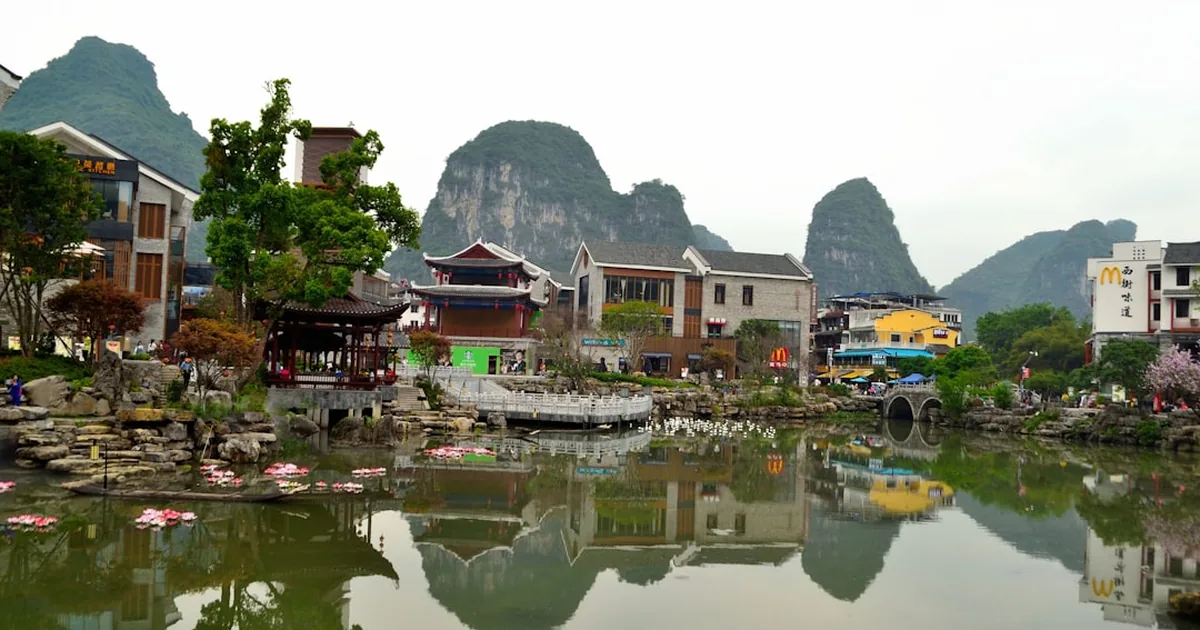
The whole region is karst — limestone mountains eaten away by millennia of water into the weird, tall, tooth-like peaks you've seen in photos. The Li River (漓江) threads through this landscape for 83 km from Guilin to Yangshuo, and that river stretch is the headline attraction of southern China.
Guilin itself is a mid-sized city of about 800,000, flat and riverside, with its own karst peaks scattered through the urban area. Yangshuo is a tourist village of 60,000 with dramatic karst walls on all sides and a famous pedestrian-plus-bar street called West Street. Between them lies the most photographed stretch of river in China.
Split your time: most travelers do 1 night in Guilin and 2-3 nights in Yangshuo. Yangshuo is the place you don't want to rush.
Getting there
Guilin is the gateway. Three practical options to reach it.
Fly into Guilin Liangjiang International Airport (KWL). Direct flights from Shanghai, Beijing, Shenzhen, Guangzhou, Hong Kong. Airport shuttle to Guilin downtown ¥20, 50-60 min. Taxi ¥110-160.
High-speed train to Guilin North Railway Station (桂林北站) or Guilin West. Guangzhou to Guilin is 2.5-3 hours (¥138-220 on 12306 or Trip.com). Shanghai is 9-10 hours (¥700+, usually not worth it). Shenzhen is 3-4 hours.
Train to Yangshuo directly: Some HSR services stop at Yangshuo Station (阳朔站), actually located 30 km from Yangshuo town in Xingping area. From there a shuttle bus takes 45-60 min to Yangshuo West Street for ¥25-35. A few travelers now skip Guilin entirely using this route, but you'll still want to see Guilin for the cruise.
Most people fly into Guilin, spend a night, do the cruise, then base in Yangshuo.
The Li River cruise: options and realities
This is the main event. Know your choices before you book.
Full Guilin-to-Yangshuo cruise (the classic)
What: 4.5 hours one-way by boat from Guilin (Zhujiang Wharf or Mopanshan Wharf) to Yangshuo. Lunch on board. The scenery from hours 2-4 is the iconic stuff, including the mountain that appears on the back of the ¥20 bill.
Price: ¥210 (basic Chinese domestic-class boat), ¥270-290 (standard international-class, better food, English announcements), ¥350-450 (premium deluxe boats with open decks and proper meals)
How to book: Trip.com, Ctrip, or through your hotel 1-3 days in advance. In high season (April-October) book a week ahead.
Timing: Boats leave 9:00-11:00 a.m., arrive Yangshuo 13:30-15:30. You end the cruise at Yangshuo, so this is the trip to do on the day you switch bases.
Downside: All on one boat for 4+ hours. If the weather is grey (and it often is), you'll see less. Food is mediocre.
Partial river tours from Yangshuo (Xingping to Yangdi)
What: Shorter 1.5-2 hour sections of the best river stretch, usually starting from Xingping (兴坪), which is 30 km upstream from Yangshuo town. Run by bamboo rafts or smaller motor boats.
Price: ¥80-140 for shared motor boats, ¥120-220 for bamboo rafts (2 people per raft, motorized)
How: Take a local bus or Didi from Yangshuo to Xingping (45-60 min), then walk or take a shuttle to the raft launch, do the cruise, return. Some day tours bundle all of this for ¥180-280 per person.
Why: You only spend 1.5-2 hours on the water but you see the best scenery (the Xingping to Yangdi stretch IS the ¥20 bill view), and you can combine it with exploring Xingping Ancient Town.
Best for: Travelers who base in Yangshuo and want a shorter, cheaper, more flexible river experience.
Which should you pick?
If you have 4-5 days, do both. Take the full cruise from Guilin as your transfer day to Yangshuo, then do the Xingping raft separately because it's a completely different (and better) view from water level. If you only have 3 days total, skip the full cruise and do a Xingping day trip from Yangshuo — you get the best scenery with less boat-time commitment.
Guilin attractions (1-2 days)
Guilin is the warm-up act. One full day covers the essentials, two is enough for a slower pace.
Reed Flute Cave (芦笛岩)
Massive limestone cave lit with colored lights. Kitschy but fun. ¥90 entry. 5 km from downtown. 1.5-2 hours on site. Bus 3 or Didi.
Elephant Trunk Hill (象鼻山)
The mountain that looks like an elephant drinking from the river, Guilin's symbol. ¥55 entry. 1 hour. You can also see it for free from the riverside park across the water; save your money if you've seen photos and the main thing you care about is a view.
Seven Star Park (七星公园)
Large riverside park with karst peaks, caves, a zoo (skip), and walking paths. ¥75 entry. 2-3 hours.
Two Rivers and Four Lakes (两江四湖)
Evening boat cruise around Guilin's waterways, lit up at night. ¥150-220 depending on boat class. 1-1.5 hours. Fun alternative to dinner out.
Xianggong Hill and Sunset Photography
If you're into photography, Xianggong Hill (30 km from Guilin, north of Yangdi) gives the single best bend-of-the-Li-River sunrise shot. ¥20 entry plus transport. Skip if you're not a photographer.
Total Guilin day-one plan: Reed Flute Cave in the morning, lunch in town, Elephant Trunk Hill or Seven Star Park afternoon, Two Rivers Four Lakes evening cruise or a proper dinner. Done.
Yangshuo essentials (2-3 days)
Yangshuo is where the trip gets good. West Street (西街) is the main drag — bars, hostels, noodle shops, souvenir stalls — but the real action is outside town in the karst countryside.
Yulong River (遇龙河)
The Yulong River runs parallel to the Li but smaller, quieter, and with no cruise boats. Bamboo rafts drift down a 15 km stretch past karst cliffs and rice paddies. ¥120-180 per raft (2 people per raft) for a 1-1.5 hour float. Book from Yangshuo town or at the raft launch at Jinlong Bridge.
Bike rentals and the Yangshuo countryside loop
You can rent a basic bike from West Street or your hotel for ¥30-60 per day. E-bikes (electric scooters) run ¥80-150. The classic loop follows the Yulong River south through villages, rice paddies, and karst walls for 15-30 km depending on how far you go. Pack water, sunscreen, and a map — Amap works fine.
Highlights of the loop:
Yulong Bridge — the old arched stone bridge at the start of the bamboo raft route, 600 years old
Jiuxian Village — sleepy preserved village, some restaurants
Xianggong Hill — optional detour for photography
Moon Hill — a karst peak with a natural moon-shaped arch near the top
Moon Hill (月亮山)
¥15 entry, 20-40 minute climb up steps to the arch, another 20 minutes to the summit if you want the full view. Go early or late to avoid midday sun. Sits on the main bike route 8 km south of Yangshuo town.
Rock climbing
Yangshuo is one of the best sport climbing destinations in Asia. Over 1,000 bolted routes across limestone walls, graded from beginner to 5.14. Popular crags include Moon Hill, Wine Bottle, and Twin Gates. A half-day guided intro climb runs ¥250-400 including gear; experienced climbers can buy the local topo book and head out independently. Guide shops along West Street rent gear and book trips — Karst Climber and ChinaClimb are established operators.
Xingping Ancient Town
Worth a half day. 30 km upstream from Yangshuo. Take a local bus (¥7.5, 1 hour) or Didi. The town itself is a small preserved cluster of stone houses; the main reason to come is the ¥20 bill view from a riverside hill 15 minutes' walk from town. Combine with a Xingping-to-Yangdi bamboo raft upstream.
Impression Liu Sanjie
Zhang Yimou's outdoor light show on the Li River, with 600 performers, bamboo boats, and the karst mountains as backdrop. ¥200-680 depending on seat. 70 minutes. Nightly shows around 8 p.m. Book through your hotel or Trip.com. Worth it if you like spectacle; a bit much if you prefer subtlety.
Longji (Dragon's Backbone) Rice Terraces day trip
The terraced rice fields 100 km north of Guilin are their own pilgrimage. Day trip is tight but doable; an overnight is better.
Logistics
From Guilin: Direct tourist buses from Guilin Bus Station (¥60-80, 2.5-3 hours) to Longji. Self-drive tours ¥250-400 per person. Day tours bundled through hotels run ¥280-450 including transport, entry, and lunch.
Entry: ¥100 combined ticket for all terraces
Two main areas: Ping An Village (most accessible, first built terraces, crowded) and Dazhai / Jinkeng Village (larger, more dramatic, quieter, requires more walking). Jinkeng has three viewing platforms reached by stone paths or a cable car.
When to go
May-June: Terraces flooded for rice planting, mirror-like water reflections. Best for photography.
July-September: Green and growing, full summer lushness.
October-early November: Golden harvest, second-best photography window.
Winter: Brown and empty, occasional snow, skip unless you like bleak beauty.
Day trip vs overnight
A day trip from Guilin gives you 3-4 hours actually at the terraces, which is enough for Ping An village if you don't hike much. An overnight in a Ping An or Dazhai guesthouse (¥150-400 a night) lets you see sunrise, sunset, and walk longer trails. If you're a photographer, overnight. If you're fitting Longji into a tight Guilin-Yangshuo trip, day trip is fine.
4-day itinerary
This is the tightest plan that actually works.
Day 1: Arrive Guilin, quick highlights
Arrive morning or midday
Lunch of Guilin rice noodles at Shidiao Milifen or Chongshan Guilin Rice Noodles
Afternoon at Reed Flute Cave
Evening: Two Rivers Four Lakes night cruise, dinner on the water or at a local spot
Day 2: Li River cruise to Yangshuo
8:00 a.m. pickup for wharf
9:00 a.m. boat departs
Full cruise to Yangshuo (4.5 hours, with lunch)
15:00 arrive Yangshuo, check in, walk West Street
Dinner: a Yangshuo beer fish (啤酒鱼) at a riverside spot
Day 3: Yangshuo countryside
Morning: bike the Yulong River loop (~20 km), including Moon Hill
Lunch at a village restaurant
Afternoon: Yulong River bamboo raft (1-1.5 hours, ¥120-180)
Evening: Impression Liu Sanjie show or a quiet dinner on West Street
Day 4: Xingping plus depart
Early morning: bus or Didi to Xingping
Walk to the ¥20 bill viewpoint
Optional: Xingping to Yangdi bamboo raft upstream
Back to Yangshuo for a noodle lunch
Transfer to Guilin North Railway Station (1.5-2 hours by direct bus) or Yangshuo Station for your onward train/flight
5-day itinerary
Add Longji before Yangshuo:
Day 1: Arrive Guilin, Reed Flute Cave, dinner
Day 2: Longji Rice Terraces day trip
Day 3: Li River cruise to Yangshuo
Day 4: Yangshuo countryside and bike loop
Day 5: Xingping half-day, afternoon departure
Food: rice noodles and beer fish
Guilin rice noodles (桂林米粉) are the region's famous dish. Nothing fancy — thick round rice noodles served with soup, slices of braised beef and pork, pickled beans, peanuts, and fried soybeans, with a spicy chili oil on the side. ¥10-20 a bowl. Every hole-in-the-wall in Guilin sells them; the best are usually the ones with lines of locals at 7 a.m.
Where to eat in Guilin
Spot | Dish | Price |
|---|---|---|
Chongshan Guilin Rice Noodles (崇善米粉) | Classic rice noodles | ¥10-18 |
Shidiao Milifen (石掉米粉) | Rice noodles | ¥10-15 |
Guilin Laodi Fangjia Fandian | Local home cooking | ¥40-80 pp |
Where to eat in Yangshuo
Spot | Dish | Price |
|---|---|---|
Lucy's | Western and Chinese, travelers' staple | ¥40-100 pp |
Cloud 9 | Upscale Yangshuo cuisine, beer fish | ¥100-200 pp |
Pure Lotus Vegetarian | Vegetarian | ¥60-120 pp |
Any street rice noodle shop | Breakfast noodles | ¥8-15 |
Yangshuo beer fish (啤酒鱼): a whole river fish (usually catfish or grass carp) braised with tomato, chili, garlic, and beer. ¥80-200 depending on fish size. A genuinely local specialty and worth trying once.
Hotels in Guilin and Yangshuo
Guilin picks
Shangri-La Guilin: Riverside, best views, luxury. ¥800-1800.
Sheraton Guilin: Central, reliable, mid-upscale. ¥500-900.
Lijiang Waterfall Hotel: Central, quirky — water cascades down the facade at night. ¥500-1000.
Ji Hotel / Atour: Mid-range chains, clean and cheap. ¥250-450.
Yangshuo picks
West Street area: Maximum walking convenience, loud at night, easy dinner options. Mid-range chains and hostels. ¥200-600.
Riverside (Li River): Hotels along the Li River outside West Street — quieter, great views. Yangshuo Phoenix Pagoda Hotel, Yangshuo Mountain Retreat. ¥400-1200.
Countryside resorts: Properties scattered among the karst 5-15 km outside town — Alila Yangshuo, Yangshuo Sudder Street, Secret Garden. For a slow-paced splurge with private scenery. ¥1000-3000.
First-timers: sleep in West Street area or just outside it for convenience. Second-time visitors or slow travelers: go countryside and never look back.
Payments, SIM, and apps
Alipay: Add a foreign card before arrival. Use for everything — tickets, food, bike rentals, cruises.
WeChat Pay: Backup.
Amap: Maps and transit. Required.
Didi: Taxis in both Guilin and Yangshuo.
Trip.com: Book cruises, hotels, day tours in English.
12306: Trains.
Travel eSIM before arrival or local SIM at the airport. VPN before landing because Google, Instagram, and WhatsApp are all blocked.
FAQ
Should I base in Guilin or Yangshuo?
Yangshuo is the main base. Spend 1 night in Guilin for logistics and a quick city look, then move to Yangshuo for 2-3 nights. Yangshuo has better scenery, better atmosphere, better bike rides, and equally good food for most budgets.
Is the Li River cruise worth it in grey weather?
Honestly, less. The karst peaks look dramatic in mist but flat in full grey. Check forecasts for cruise day. If it's solid rain, switch to a Xingping-day-trip-by-bus plan where you can shelter and still see the river scenery from land.
How do I get from Yangshuo to Guilin Airport?
Direct shuttle buses run ¥80-120 and take 1.5-2 hours, leaving roughly hourly from Yangshuo Bus Station. Book through your hotel or just show up an hour early. A private Didi is ¥350-500. Plan 3+ hours of buffer before international flights.
Is rock climbing safe for beginners in Yangshuo?
Yes, with a guide. Local climbing schools run half-day intro trips for people who've never touched a rope, including all gear and a belay. The rock is good and the grades are well established. Book through shops on West Street.
When is the best month to visit Guilin and Yangshuo?
April-June and September-October. April-May gets the flooded rice terraces at Longji. October has clearer skies and harvest colors. July-August is hot, humid, and often rainy, but the karst looks lushest. Winter is cool and grey; skip unless you don't mind bare scenery.
Can I do Guilin and Yangshuo in 2 days?
Only if you skip Guilin's sights entirely. Day 1: arrive Guilin, immediately do the Li River cruise to Yangshuo, arrive afternoon. Day 2: one morning of biking in Yangshuo, then transfer out. You'll wish you had more time — this region rewards slow travel.
Tags
Heading to China soon?
Take every guide offline — translation, payments, maps, and emergency help in one free app.