First-Time China Trip for Teens 2026: Safe & Smart Guide
Quick answer: A first China trip for teens works best as a 7-10 day Beijing-Shanghai loop, with Xi'an or Chengdu added for longer stays. The biggest gotcha: a teen under 18 cannot open their own Alipay, so payments run through a parent's account. Bring a pre-installed travel eSIM so the teen's Instagram and Snapchat work without a VPN.
A first China trip with a teenager works best as a 7-10 day loop through Beijing, Xi'an, Chengdu or Shanghai with a mix of hands-on history (Mutianyu Great Wall, Terracotta Warriors, Chengdu Panda Base), teen-pull attractions (Shanghai Disney Resort, 798 Art District, bubble tea delivery crawls), and enough free time for Xiaohongshu photo hunts. Budget ¥8,000-¥15,000 per person land-only, and plan for a guardian to travel with anyone under 18 — hotels and Chinese domestic airlines generally won't accept unaccompanied minors.
What this guide covers
A realistic 7-10 day teen-friendly itinerary with HSR between cities
Activities teenagers actually enjoy (with Xiaohongshu and Douyin in mind)
App setup: Xiaohongshu, Amap, Didi, Meituan, plus VPN/eSIM for Instagram
Food adventurousness — what teens usually love and what surprises them
Safety notes, emergency numbers, and the parental supervision reality
Packing checklist and ¥ budget per day
Heading to China soon?
Take every guide offline — translation, payments, maps, and emergency help in one free app.
Why China Works for Teens in 2026
Teenagers who grew up on TikTok and Netflix arrive in China with more context than they think. Xiaohongshu (Little Red Book) has become the default Gen Z research app for global travelers and it works perfectly on a mainland SIM. The Chengdu Panda Base, Mutianyu Great Wall toboggan, Shanghai Disney Resort, the Xi'an city-wall bike loop, and the entire Chongqing-style light-rail-through-a-building are all Xiaohongshu megahits with thousands of daily teen posts.
The hard stuff — language barrier, payments, visa — is all solvable with a parent's 30 minutes of pre-trip setup. China in 2026 is arguably easier for tech-native teens than it is for their parents, because navigating apps is second nature.
The 7-10 Day Itinerary
7-day compact loop (Beijing + Shanghai)
Best for spring or fall break visitors who can only take one week. Heavy on icons, light on travel days.
Day 1 — Arrive Beijing Capital (PEK) or Daxing (PKX). Settle in near Wangfujing or Qianmen. Jet-lag dinner at a dumpling shop, early to bed.
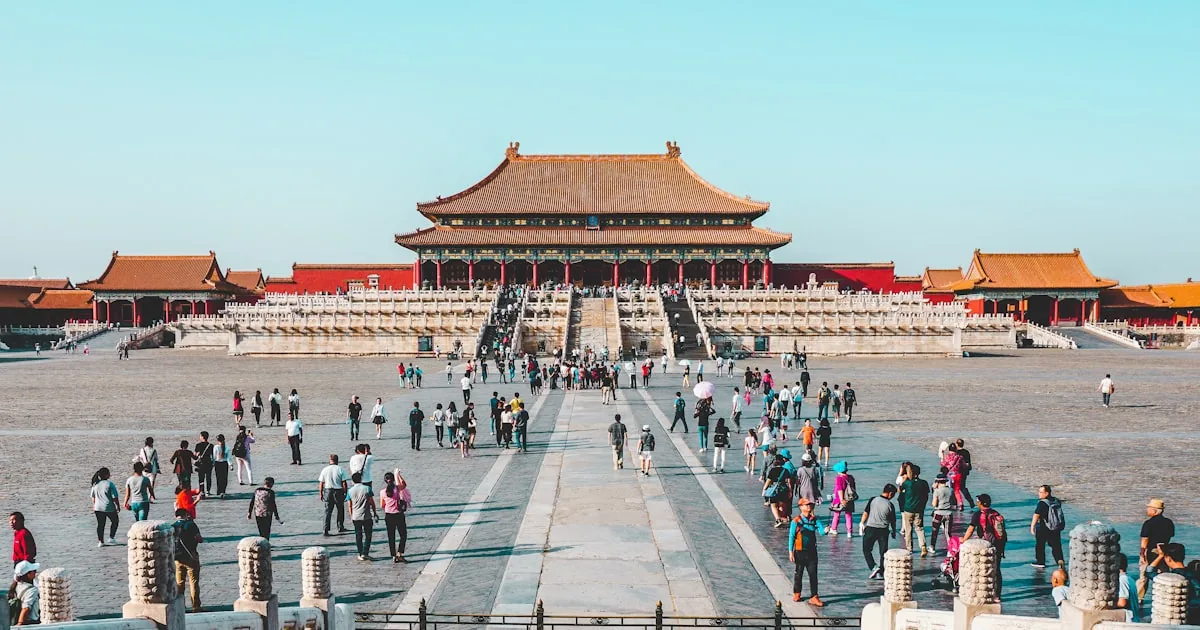
Day 2 — Forbidden City morning, Jingshan Park viewpoint, Qianmen evening walk. Introduce the teen to Alipay QR scanning at a bubble tea shop.
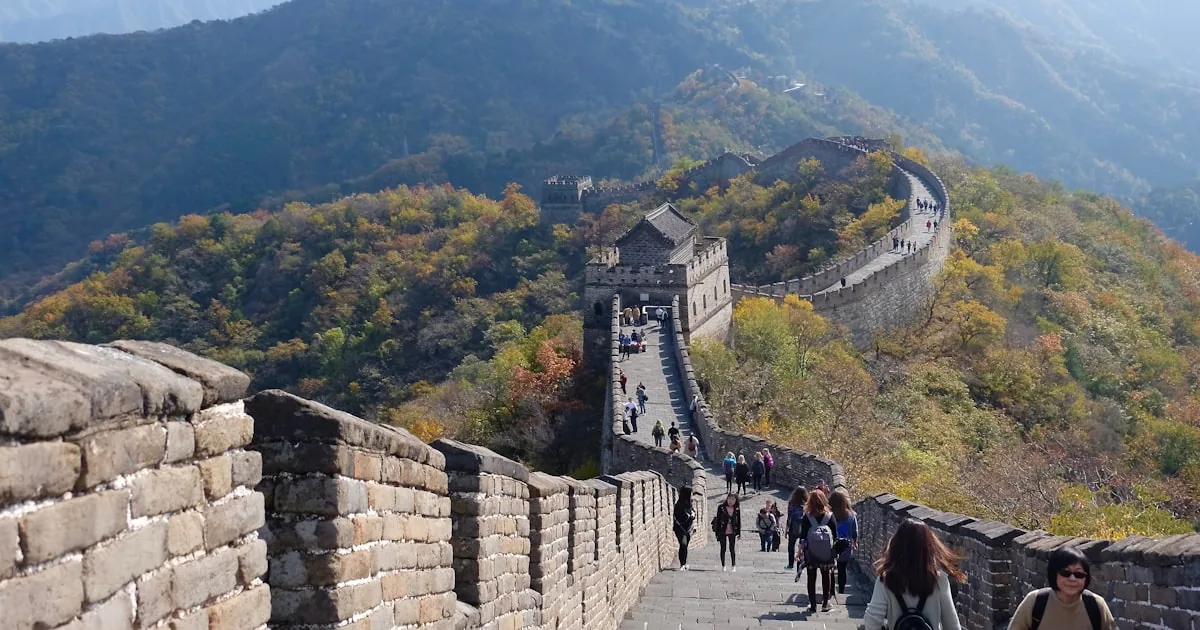
Day 3 — Mutianyu Great Wall day trip. Take the cable car up, walk 4-6 watchtowers, ride the toboggan down. This is the highlight for most teens.
Day 4 — Temple of Heaven morning, 798 Art Zone afternoon (contemporary art, cafes, photo-friendly for Xiaohongshu), hutong dinner.
Day 5 — Morning HSR Beijing South to Shanghai Hongqiao (G1, 4h28m, ¥553 second class). Afternoon at the Bund, Nanjing Road, dinner in Xintiandi.
Day 6 — Shanghai Disney Resort full day. Get Premier Access or Early Park Entry tickets if budget allows; standby queues average 60-90 minutes for headliners.
Day 7 — Yu Garden morning, Tianzifang lane crawl, Pudong skyline sunset cruise, late flight home from PVG.
10-day extended loop (Beijing + Xi'an + Chengdu + Shanghai)
Adds two more cities and two genuine teen highlights: Terracotta Warriors and the Chengdu Panda Base.
Days 1-4 — Beijing as above.
Day 5 — Morning HSR Beijing West to Xi'an North (G87 or similar, 4h18m). Afternoon Xi'an city wall bike rental, Muslim Quarter food crawl for dinner.
Day 6 — Terracotta Warriors half-day tour (90 minutes each way by bus or Didi), Big Wild Goose Pagoda fountain show in the evening.
Day 7 — Morning HSR Xi'an to Chengdu East (3-4h). Afternoon Jinli Street and Wide and Narrow Alleys.
Day 8 — Chengdu Research Base of Giant Panda Breeding early morning (pandas are most active 8-10 AM). Afternoon People's Park tea house. Dinner: a mild hotpot introduction at a tourist-friendly spot like Xiao Long Kan or Haidilao.
Day 9 — Morning HSR Chengdu East to Shanghai Hongqiao (G-train 11 hours or a 2h30m flight if HSR feels too long). Afternoon Bund walk.
Day 10 — Shanghai Disney Resort OR Yu Garden plus Tianzifang depending on teen preference, late PVG departure.
HSR between cities (2026 verified prices)
Leg | Second class | First class | Duration |
|---|---|---|---|
Beijing to Xi'an (G-train) | ¥515 | ¥824 | ~4h18m |
Xi'an to Chengdu (G-train) | ¥263 | ¥421 | ~3h30m |
Chengdu to Shanghai (G-train) | ¥874 | ¥1,399 | ~10-11h |
Beijing to Shanghai (G1 reference) | ¥553 | ¥933 | ~4h28m |
For families with under-16s, consider first class on the longer Chengdu-Shanghai leg — the extra ¥500 per ticket buys wider seats, quieter cabins, and a lot less restlessness. Or fly that leg: Sichuan Airlines, China Eastern, and Spring Airlines all run CTU-SHA or CTU-PVG routes under ¥800 on standard economy in 2026.
Activities Teens Actually Enjoy
Every activity below has a real Xiaohongshu and Douyin fan base, which is the single best proxy for "will a 15-year-old enjoy this."
Mutianyu Great Wall toboggan ride — 1,580 meters of downhill track after cable-car entry. ¥220 all-in, includes ascent and descent. A universal teen hit.
Chengdu Panda Base — Arrive at 07:30 when gates open. Giant pandas nap most afternoons, so morning visits win. ¥55 entry.
Shanghai Disney Resort — Full day. Standard tickets in 2026 run ¥475-¥799 depending on peak or off-peak dates. Download the Shanghai Disney Resort app for queue times.
Terracotta Warriors — ¥120 entry, plus ¥45 shuttle round-trip from Xi'an city. An hour on site is usually enough. The teen angle: photos in Pit 1 under the vaulted shed.
Xi'an city wall bike loop — 14 km all the way around the Ming-dynasty walls. Bike rental ¥45 for 100 minutes. One of Xi'an's best golden-hour photo spots.
798 Art District — Free entry to the neighborhood, individual galleries ¥20-60. Bubble tea shops, graffiti walls, pop-up exhibits, and a skateboard scene. Pure Xiaohongshu bait.
Chongqing Liziba light rail-through-a-building — The train actually runs through floors 6-8 of a residential tower. Free to photograph from the observation deck; ¥3 to ride the train.
Shanghai Nanjing Road + the Bund at night — Free, walkable, with the skyline lit up after 19:00.
Bubble tea delivery tours — Use Meituan or Eleme to order Heytea, Nayuki, Chagee, or Mixue to your hotel. Compare 4-6 brands in a single afternoon.
Dumpling-making class — Available in most major cities through GetYourGuide, Viator, or Klook. ¥150-300 per person, 2-3 hours.
Two things teens often want to try in China come with legal age rules foreign families rarely expect. Escape rooms and script-murder games (mi shi tao tuo and ju ben sha, hugely popular with Chinese teens) are restricted for minors: venues may only admit under-18s outside school hours, meaning on public holidays, weekends and during summer/winter break, and players under 14 must be accompanied by a parent. Separately, internet cafes, bars and KTV (karaoke parlours) are legally off-limits to anyone under 18 entirely, even when a parent is present, under China's Minor Protection Law. Plan around this: choose daytime, family-rated escape rooms during holidays, and skip KTV as a teen activity.
Shanghai Disneyland uses real-name, passport-as-ticket entry, which trips up first-timers. There are no e-tickets: you buy in advance tied to each person's exact passport name and number, and on the day each guest must present the original physical passport used at purchase. Photocopies and phone screenshots are rejected, staff scan and photograph at the gate, and a ticket becomes invalid if that passport is renewed before the visit. Book a couple of weeks ahead through the official site or a partner like Klook, and double-check every passport number before paying.
App Setup for Teens
Parents should set up the core payment apps, but hand over the navigation and social apps to the teen. They'll use them far more aggressively.
On parent's phone (primary payment)
Alipay with Tour Pass activated and a parent's Visa or Mastercard linked. Tops up in ¥2,000 increments.
WeChat Pay as backup, completed with real-name verification.
Trip.com for HSR and hotel bookings in English.
12306 official rail app in English for last-minute ticket changes.
On teen's phone (primary navigation and social)
Amap (Gaode Maps) set to English. Far more accurate than Apple Maps or Baidu for walking directions in hutong neighborhoods.
Didi for ride-hailing. Works in English, pays through Alipay or WeChat Pay linked via QR.
Xiaohongshu (Little Red Book) — the single best source for teen-relevant Shanghai cafe, Beijing bubble tea, and Chengdu hotpot recommendations.
Douyin (Chinese TikTok) for location videos.
Meituan or Eleme for food delivery and bubble tea.
Pleco offline Chinese dictionary with camera OCR for menus.
Google Translate with downloaded offline Chinese pack.
The Instagram question
Instagram, Snapchat, WhatsApp, Facebook, and YouTube are blocked on mainland Chinese SIMs in 2026. Teens who need to post daily to Instagram have three options:
Pre-installed VPN: Unreliable in 2026 as enforcement tightens. Back up with another option.
Roaming eSIM from Airalo, Nomad, or Holafly that routes through Hong Kong or Singapore. This bypasses the Great Firewall cleanly and is the most reliable 2026 method.
Wait until hotel Wi-Fi: Most international chain hotels in Beijing and Shanghai run VPN-enabled guest networks that reach blocked services. Spotty in smaller cities.
Xiaohongshu fully replaces Instagram for a teen who's willing to learn a new app — the Chinese interface is genuinely excellent for travel content.
A teenager under 18 cannot complete real-name verification on Alipay, which means they cannot open a usable Alipay account of their own or link a bank/credit card to it. WeChat is less strict for messaging, but binding an international card for WeChat Pay also effectively requires an 18-plus passport holder. The practical upshot: do not waste time at the airport trying to set up a teen's own payment app. Load all spending onto a parent's verified Alipay or WeChat Pay, hand the teen cash or a parent-controlled top-up for small buys, and keep the parent's phone as the family wallet for transit, attractions, and food.
An international travel eSIM, installed before you fly, is the single best fix for a teen's social media. Because the eSIM routes data through a roaming server outside mainland China, Instagram, Snapchat, TikTok, YouTube and WhatsApp load normally without any VPN at all. The catch most guides miss: you must buy and install the eSIM before entering China, because the provider's app and top-up pages are themselves blocked once you land. Turn Data Roaming ON for the eSIM in your phone settings the moment you arrive, or the bypass will not work.
Food: What Teens Usually Love
Chinese food outside the Westernized takeaway canon surprises a lot of first-time teen travelers. The general pattern: they arrive cautious, try soup dumplings at Din Tai Fung or a Shanghai street shop, and by day three are ordering jianbing from a street vendor on Xiaohongshu's recommendation.
Xiaolongbao (soup dumplings) at Din Tai Fung or Jia Jia Tang Bao in Shanghai — universally liked.
Peking duck at Quanjude or Siji Minfu in Beijing — a dinner event.
Lanzhou beef noodles in Xi'an or Beijing — hand-pulled, cheap (¥20-35), filling.
Jianbing street crepes from morning vendors — ¥8-12, excellent breakfast.
Hotpot at a tourist-friendly chain like Haidilao or Xiao Long Kan — order the mild yuan yang split pot and let each person control their own dipping bowl.
Sichuan sweet water noodles (tian shui mian) — sweet, sesame, not spicy, surprisingly good to teens.
Bubble tea — Heytea, Nayuki, Chagee, Mixue. ¥15-35 per cup. An entire social ritual for Chinese teens and contagious.
Candied hawthorn (tanghulu) — the caramelized-skewer street snack, ¥10-15.
Go easy on the Sichuan spice on day one. Ask for wei la (slightly spicy) rather than zhong la (medium) or te la (very spicy) until you know the teen's tolerance.
Safety, Supervision, and Parental Reality
China is one of the safest destinations for family travelers. Violent crime against tourists is rare. The real risks are tourist-site pickpocketing, unlicensed airport taxi touts, and "English practice" tea-house scams in Beijing and Shanghai.
The supervision rule
Teens under 18 cannot check into most Chinese hotels alone. Airlines won't board unaccompanied minors on domestic flights above a certain age threshold without documented escort arrangements. If you're planning a trip with a 17- or 18-year-old, the practical answer is one of:
A parent or legal guardian travels along the entire time
The teen joins a licensed youth travel operator like EF Tours or CET with continuous documented adult supervision
The teen stays with a verified Chinese host family through a formal exchange program
Notarized and embassy-legalized parental consent letters (three printed copies, one for immigration, one for the first hotel, one backup) are required when a minor travels with only one parent or a non-parent guardian.
Emergency numbers (save these on the teen's phone)
Police: 110
Ambulance: 120
Fire: 119
Tourist Hotline (English): 12301
Your country's embassy in Beijing
Water, pharmacies, insurance
Tap water is not potable anywhere in mainland China — bottled or boiled only. Pharmacies (药店, yao dian) sell OTC medicines without prescription; international-brand ibuprofen, loratadine, and electrolyte sachets are all available. Travel insurance with emergency medical evacuation cover is strongly recommended for family trips.
China is unusually safe for teens by international standards, with low violent-crime rates and heavily monitored public transit, but the real risk for a foreign teenager is getting separated without a working phone or payment. Before you split up for any reason, confirm three things on the teen's phone: a charged battery with a power bank, the parent's WeChat as a saved contact for live location sharing, and a screenshot of the hotel name and address written in Chinese characters (taxi drivers and police rarely read pinyin). Agree on a fixed meet-up landmark at every major site in case data drops.
Packing Checklist and Budget
Teen packing essentials
Passport plus two photocopies plus a scan saved to the teen's phone
Universal plug adapter (China uses Type A, C, and I, 220V)
Portable power bank (10,000-20,000 mAh)
Comfortable walking shoes — 20,000+ steps per day is normal
Layered clothing (Beijing is cold November-March; Chengdu and Shanghai can be humid in summer)
Copies of hotel reservations and HSR tickets printed (backup)
Parent's emergency contact card in Chinese and English
Budget per day (per teen, land only)
Category | Budget | Mid-range | Comfort |
|---|---|---|---|
Hotel (shared with parent) | ¥200 | ¥450 | ¥850 |
Meals (3 per day) | ¥120 | ¥220 | ¥380 |
Attractions and activities | ¥80 | ¥180 | ¥350 |
Transport (metro + Didi) | ¥30 | ¥70 | ¥150 |
Daily total | ¥430 | ¥920 | ¥1,730 |
A 10-day mid-range family trip for one teen lands at roughly ¥9,200 (about $1,280 USD) ground-only. Shanghai Disney pushes the activities line up on the day you visit.
Budget for adult-price tickets even for teenagers. Foreign-passport visitors get no child or student discount at most mainland attractions: at the Forbidden City, for example, foreign children pay the full adult fare, and China's railways do not offer the student rail discount to foreign students. International Student Identity Cards (ISIC) are honoured at some museums but rarely at headline sights like the Great Wall, so do not count on a teen or student card to cut entry costs. Carry the card anyway, but ask at each ticket window rather than assuming a discount exists.
Frequently Asked Questions
Can a 16-year-old travel to China without a parent?
Legally and practically, no — not independently. Hotels require parental consent for minors, airlines have policies against certain ages traveling alone, and the standard tourist L visa application strongly prefers adult accompaniment. The workable options are a guardian parent, a licensed youth tour operator (EF Tours, CET), or a formal exchange program.
Does Shanghai Disney need advance tickets in 2026?
Yes. Peak-date tickets sell out 2-4 weeks ahead during Chinese holidays and Western summer break. Buy through the Shanghai Disney Resort app, Klook, or Trip.com. Early Park Entry and Premier Access add-ons cost extra but save 60-90 minutes per ride at headliners like TRON Lightcycle Run.
Will teen Instagram and Snapchat work in China?
Not on a mainland SIM. Use an eSIM that roams through Hong Kong or Singapore (Airalo, Nomad, Holafly), a pre-installed VPN as a backup, or international hotel Wi-Fi. Xiaohongshu, Douyin, and Meituan all work perfectly on a Chinese SIM.
Is Chinese street food safe for teenagers?
In regulated tourist zones (Xi'an Muslim Quarter, Wangfujing Snack Street, Chengdu Jinli, Shanghai Yu Garden bazaar) yes, with normal precautions: look for busy stalls with high turnover, avoid anything that looks reheated, and skip raw seafood unless you're at a proper restaurant. Carry hand sanitizer and loperamide as a precaution.
What's the best month for a teen China trip?
April, May, September, and October give the best weather across Beijing, Xi'an, Chengdu, and Shanghai. July and August are hot and humid; avoid them if you can. Winter (December to February) is cold in Beijing but Disney queues are shortest.
Tags
Heading to China soon?
Take every guide offline — translation, payments, maps, and emergency help in one free app.
Travelers also asked
View all →- What is the single best destination to prioritize for a first trip to China?
- Is China worth visiting despite negative media portrayals?
- Is the proposed itinerary duration suitable for a first trip, and are there specific stopover recommendations?
- How difficult is independent travel in China regarding transport and payments, and are local guides necessary?