China Train Luggage Rules for Foreigners: Weight, Size and Security
On this page11 sections
- 01Official luggage limits at a glance
- 02Is luggage weighed at every station?
- 03Where luggage goes on a high-speed train
- 04Station security: what to expect
- 05Power banks, liquids and everyday toiletries
- 06Food on China trains
- 07Traveling with sports, musical or unusual equipment
- 08Luggage strategy for a multi-city trip
- 09Boarding with luggage step by step
- 10Frequently asked questions
- 11Sources
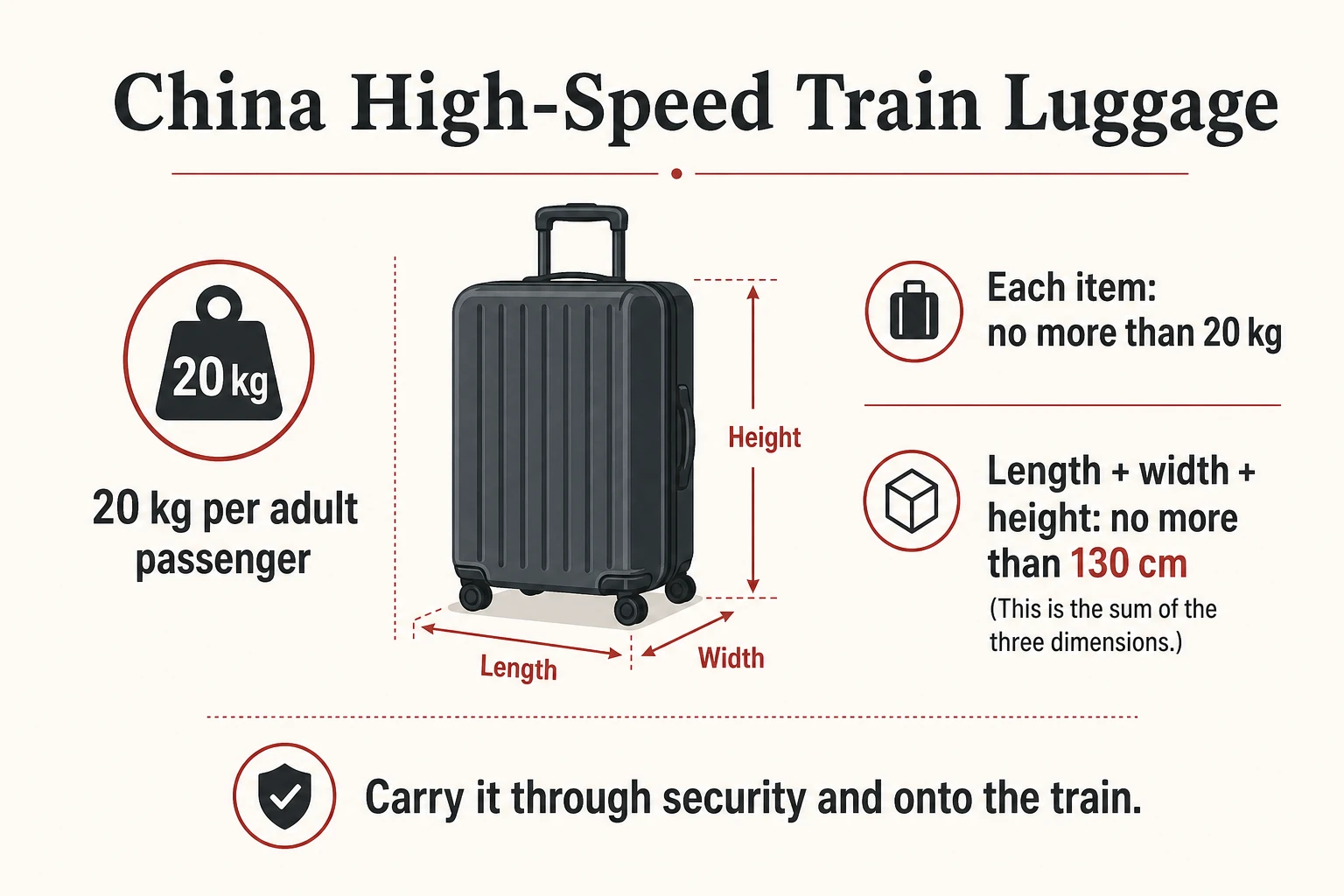
An adult passenger on a China train normally has a free carry-on allowance of 20 kg. On an EMU/high-speed train, the published maximum total of length, width and height is 130 cm, and a single item should not exceed 20 kg. The allowance is not a checked-baggage entitlement: you carry the luggage through security, onto the train and into the available storage yourself.
For most tourists, one normal suitcase plus a day bag is manageable. Two very large cases may be within a combined weight estimate yet still be awkward to screen, lift and store.
Official luggage limits at a glance
Passenger/item | Published free limit |
|---|---|
Normal passenger | 20 kg |
Child passenger | 10 kg |
Diplomatic passenger | 35 kg |
Each individual item | No more than 20 kg |
EMU/high-speed train dimensions | Length + width + height no more than 130 cm |
Conventional train dimensions | Length + width + height no more than 160 cm |
A folding wheelchair used by a passenger with a disability is not counted toward the normal dimension rule in the same way as ordinary luggage.
These are China Railway's published limits. Station staff can refuse items that obstruct operations, endanger other passengers or violate the prohibited-items rules even if the scale reading is low.
Getting around China without Chinese?
Save routes and key phrases offline — show your driver the address in Chinese with one tap.
Is luggage weighed at every station?
Do not build a packing plan around the assumption that nobody will weigh it. Screening practice varies by station and by the item that attracts attention. The enforceable rule is the published allowance, not what a previous traveler happened to experience.
The more immediate constraint is often physical. You need to move the bag through the station, place it through the X-ray machine, board during a limited window and lift it into a rack or luggage area without blocking the aisle.
If you cannot lift the suitcase safely, reduce it or arrange separate delivery. Train staff and other passengers are not a guaranteed porter service.
Where luggage goes on a high-speed train
High-speed trains normally provide overhead racks for smaller bags and luggage spaces in parts of the carriage for larger cases. The exact layout depends on the train set and coach. Space is shared and is not reserved with your seat.
Keep these points in mind:
small bags belong on the overhead rack or where crew instructions permit;
large suitcases are easier to place in a carriage-end luggage area;
aisles, doors and emergency equipment must remain clear;
valuables, medication, documents and batteries should stay with you;
a luggage cable or distinctive strap can help identify a similar suitcase, but must not obstruct others.
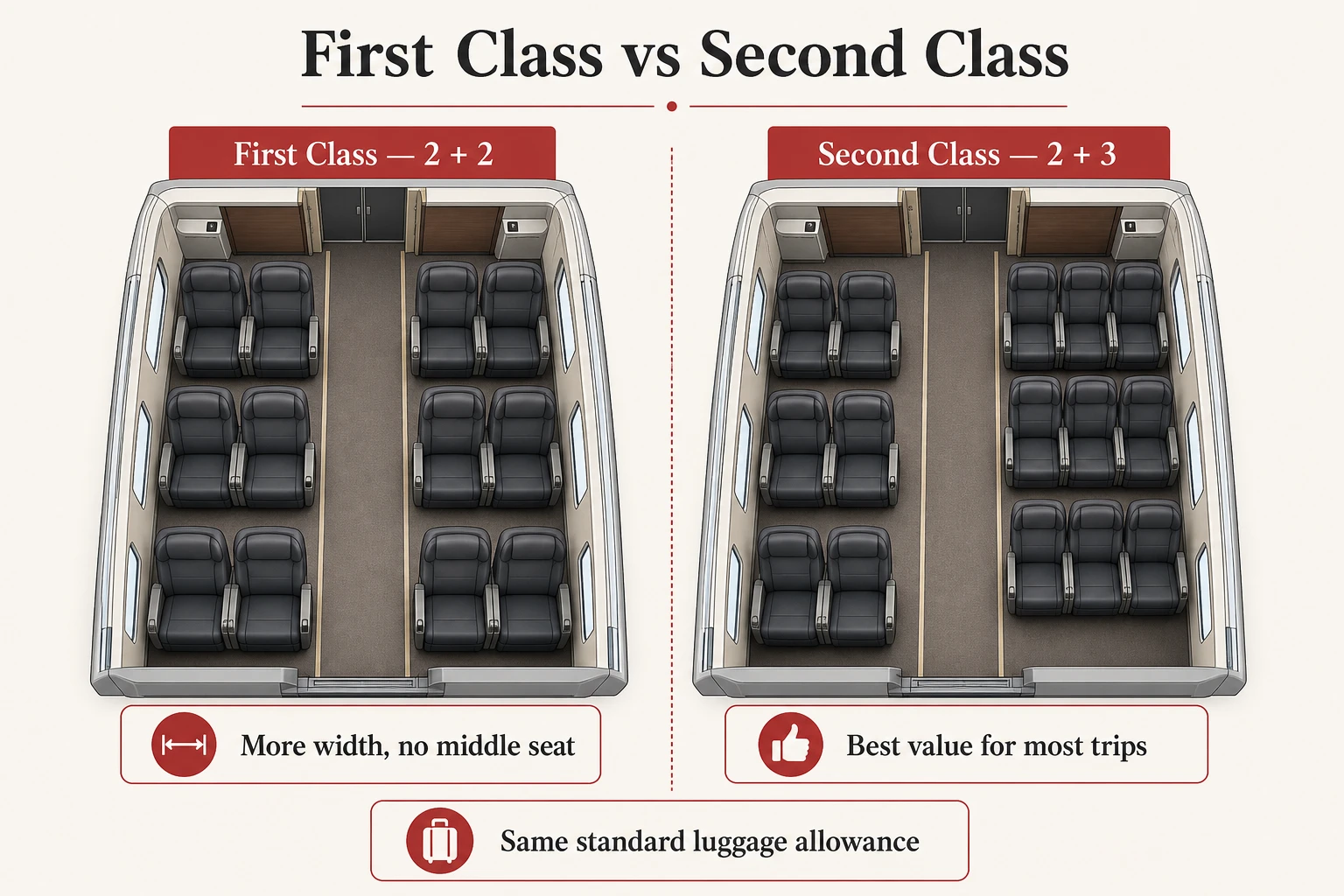
Boarding early within the permitted window gives you more time to place luggage, but it does not guarantee a specific storage bay. If you are comparing seat classes only for baggage, read first class vs second class on China trains: both classes use shared luggage storage, and the published baggage allowance does not become larger with a first-class ticket.
Station security: what to expect
All passengers and belongings pass through railway security inspection. At a typical station, your suitcase and bags go through an X-ray scanner while you pass a person-screening checkpoint. Staff may ask to inspect or test an item that cannot be identified clearly.
Security lines can be the slowest part of entering the station. Arrive with enough time to complete screening, find the waiting area and reach the gate before it closes. This is especially important if you are using a staffed passport lane for the e-ticket.
The national restricted-items list covers categories including weapons, explosives, flammable materials, toxic and corrosive substances, and controlled or limited everyday products. The limits for aerosols, alcohol, power banks and other items can be updated or depend on labeling and capacity. Check the current official list rather than copying a number from an old forum post.
Power banks, liquids and everyday toiletries
Rail security is not identical to airport security. Ordinary drinks and toiletries are not governed by a universal airport-style 100 ml liquid rule, but a suspicious, leaking, unlabeled or flammable product may still be examined or refused.
Power banks should have a clear capacity and safety marking and must comply with the current railway restricted-items rules. Keep them accessible for inspection instead of burying them under clothes. The same principle applies to aerosols, lighters and alcohol: read the current category and quantity limit before packing.
If an item matters to your trip and sits near a regulatory limit, use the official prohibited and restricted items list and current 12306 guidance. A social-media packing list is not an authority at the checkpoint.
Food on China trains
Normal packed food is generally practical, but pack for a shared carriage. Choose containers that seal, avoid spill-prone soups and keep strong smells under control. High-speed services often sell food and drinks, but selection, timing and payment options vary.
Bring water and a simple meal for a long journey if you have dietary restrictions. Do not fill the luggage rack with an open food bag that can leak onto another passenger's belongings.
Traveling with sports, musical or unusual equipment
The standard size and safety rules still apply. A bicycle, large instrument, long pole, tool or bulky sports case may not fit the 130 cm total-dimension limit for an EMU train. Do not assume that buying an extra passenger ticket creates a checked-baggage service.
Before travel, contact 12306 or the departure station with the item's exact dimensions, weight and contents. If it cannot travel as passenger luggage, arrange rail consignment or a commercial delivery service separately. Allow enough time for the item to arrive; it may not travel on your train.
Luggage strategy for a multi-city trip
China's high-speed rail is easiest when you can move every bag in one trip. A practical setup is:
one medium suitcase or travel pack;
one compact personal bag for passport, wallet, phone and medication;
a foldable tote for food or temporary overflow;
a visible name tag with an email address, not sensitive passport information.
Use hotel luggage storage between check-out and departure where available. For a same-day city stop, station lockers or storage services may exist, but availability, hours and ID requirements vary. Verify at the specific station instead of assuming every rail hub has identical facilities.
Pack for the transfer, not only the time on board. You may need to lift the bag through security, move it across a large station and load it while other passengers are boarding. Keep the weight within what you can handle without blocking the aisle. Put medication, passport, charging cable and one warm layer in the personal bag so they remain accessible even when the suitcase is at the end of the coach. Close loose straps before the X-ray and avoid attaching an open cup, umbrella or shopping bag that can fall during boarding. If two people share one very heavy case, compare that inconvenience with carrying two smaller bags.
Boarding with luggage step by step
Confirm the exact station and entrance.
Keep the original passport and ticket order easy to reach.
Put liquids, batteries and unusual objects where security staff can inspect them.
Pass all bags through the X-ray machine.
Check the gate and platform on the station display.
Board the correct coach and place large luggage without blocking the aisle.
Keep valuables with you and recheck the storage area before leaving.
If you have not booked yet, the 12306 English guide for foreign travelers covers passport entry, e-tickets, changes and refunds.
Frequently asked questions
Can I bring a 28-inch suitcase on a China high-speed train?
Measure it. Add length, width and height, including wheels and handles. The published EMU limit is 130 cm total, and the item must be practical to screen and store. “28 inch” is a marketing category, not the railway's measurement.
Does first class include more luggage?
The standard published passenger allowance is not increased simply because you buy first class. First-class coaches may feel less crowded, but storage layout and occupancy vary.
Can I check a bag like on an airplane?
Your normal train ticket is based on carry-on luggage. Oversized or unmanageable items need a separate consignment or delivery plan where available.
Are knives allowed?
Weapon and blade restrictions are specific. Check the current official list for the exact item; do not pack a knife based on an anecdote from another station.
How early should I arrive with large luggage?
There is no single correct number for every station. Add time for security, a possible manual passport lane, walking to the gate and placing the bag. Major holiday periods require a larger buffer.
Sources
China Railway 12306 English FAQ: passenger luggage, checked 2026-07-16.
Railway passenger security-inspection regulation, effective 2024-02-01.
National prohibited and restricted items list, checked 2026-07-16.
Tags
Getting around China without Chinese?
Save routes and key phrases offline — show your driver the address in Chinese with one tap.