China Train First Class vs Second Class: Seats, Luggage and Value
On this page13 sections
- 01First class vs second class at a glance
- 02What second class is actually like
- 03What first class changes
- 04Seat pitch, recline and power outlets
- 05Luggage: first class is not a bigger baggage ticket
- 06Is first class quieter?
- 07Choose the seat pattern, not a fantasy seat
- 08How much more does first class cost?
- 09Which class for popular journey types?
- 10Booking the class you intend to travel in
- 11A simple recommendation
- 12Frequently asked questions
- 13Sources
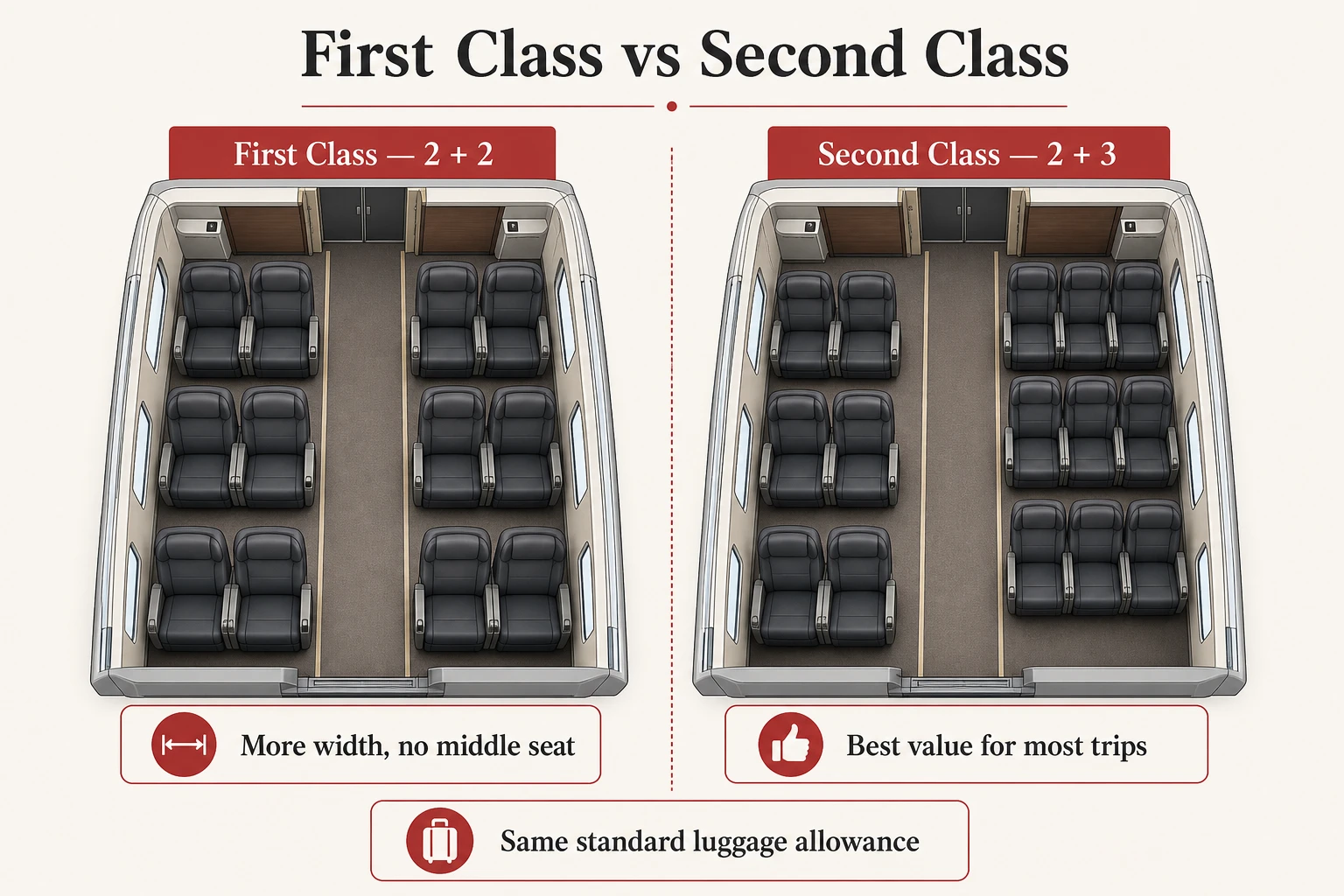
On a typical Fuxing high-speed train, first class uses a 2+2 seat layout and second class uses 2+3. First class gives each passenger more width and fewer people in the row; second class is the value choice and is comfortable enough for most journeys. The upgrade is most useful on a long trip, for a larger traveler, or when two people want a pair of seats without a middle seat.
Do not choose by class name alone. Compare the live fare, journey length, departure time and specific train before paying. Train models and refits vary, so a feature seen in one video is not guaranteed across the network.
First class vs second class at a glance
Feature | First class | Second class |
|---|---|---|
Common Fuxing layout | 2+2 | 2+3 |
Middle seat | No | Yes, in the three-seat side |
Personal width | More | Less |
Row density | Lower | Higher |
Luggage allowance | Standard passenger allowance | Standard passenger allowance |
Best for | Long rides, pairs, extra personal space | Most travelers and shorter trips |
Fare | Higher; route-specific | Lower; route-specific |
CRRC's official Fuxing guide confirms the core layout difference. It also shows adjustable seats, tray tables and large-luggage areas. The precise seat, outlet and table design can differ by train set.
Getting around China without Chinese?
Save routes and key phrases offline — show your driver the address in Chinese with one tap.
What second class is actually like
Second class is the standard high-speed-rail product, not a standing-room budget cabin. Seats are arranged two on one side of the aisle and three on the other. You receive an assigned coach and seat.
For one traveler, the two-seat side avoids a middle seat. For a group of three, the three-seat row can be convenient. For a couple, two seats together on the two-seat side are ideal, but seat preference is subject to the booking system and availability.
Second class works well when:
the journey is a few hours;
the fare difference is substantial;
you are traveling light;
you plan to read, watch downloaded media or sleep;
schedule matters more than cabin space.
The carriage can feel busy during holidays, and the middle seat offers less personal space. That is a density tradeoff, not a reason to avoid second class categorically.
What first class changes
First class removes the three-seat side and uses two seats on both sides of the aisle. The result is more seat width, a less crowded row and no middle seat. It is still a normal shared railway coach, not the enclosed premium experience associated with airline first class.
First class is easier to justify when:
the trip takes most of the day;
you are tall or broad and value shoulder room;
you need to work on a laptop;
two people want to sit as a pair;
the live fare difference is modest relative to the total trip cost;
you are traveling at a crowded time and prefer a lower-density coach.
The upgrade does not make the train faster. First and second class on the same train depart and arrive together.
Seat pitch, recline and power outlets
Avoid planning around a universal legroom measurement. China uses several high-speed train families and configurations. Seat pitch, tray design, recline and socket location can vary even within the broad Fuxing category.
Many current trains provide power at the seats, but the location and connector can differ. Carry a charged power bank that complies with current railway security rules, and download essential tickets and media before boarding. Do not reserve first class only because an old review shows a particular outlet.
If a specific accessibility or seating feature is essential, ask 12306 about the train and assistance options rather than relying on a generic carriage photo.
Luggage: first class is not a bigger baggage ticket
China Railway's standard free luggage limit for a normal passenger is 20 kg, subject to dimension and safety rules. Buying first class does not automatically increase that published allowance.
Both classes have overhead racks and access to shared large-luggage spaces, but the exact arrangement varies. A lower-density first-class coach may feel easier with luggage on some departures; it is not a reserved storage guarantee.
Read the full China train luggage rules before bringing a large case. The published size limit for an EMU/high-speed train is based on the sum of length, width and height, not the retail suitcase label.
Is first class quieter?
Often it feels calmer because fewer passengers occupy the coach, but there is no silence guarantee. Families, phone calls, announcements and boarding activity can occur in any class. Bring headphones or earplugs if quiet matters.
If you need privacy, compare business class where offered. Business class is a separate product with a much higher price and different seat design; it should not be treated as a small extension of the first-class upgrade.
Choose the seat pattern, not a fantasy seat
Second class normally has a three-seat side and a two-seat side, so it is the only one of these two classes that can assign a true middle seat. First class's 2+2 pattern removes that problem, but it does not guarantee an empty neighboring seat, a particular view or a carriage facing the direction of travel.
For two travelers, first class makes pairing simple. In second class, a window-and-aisle pair may be separated by another passenger if the confirmed seats are on the three-seat side. For three travelers, that same three-seat side can be more convenient than splitting the group across an aisle.
Book everyone in one order when possible and inspect the coach and seat numbers after confirmation. Assignment still depends on inventory. If sitting together is essential because a child or companion needs assistance, do not wait until the train is moving to discover a split; ask official staff what can be done before boarding and accept that a change may not be available.
How much more does first class cost?
There is no honest network-wide percentage. Fare differences depend on route, distance, train and current availability. Open the same train in 12306 and compare the displayed first- and second-class prices.
Use this value test:
Subtract the second-class fare from the first-class fare.
Divide the difference by journey hours.
Ask whether that hourly cost is worth more width and a 2+2 layout to you.
Compare a better departure time in second class with a worse time in first.
A well-timed second-class train often creates more travel value than a premium seat that forces an early start or late hotel arrival.
Which class for popular journey types?
Beijing to Shanghai
This is long enough for first class to be noticeable, especially if you will work. Second class remains a rational choice for budget-conscious travelers, and saving the fare difference for a better-located hotel may improve the trip more.
Shanghai to Hangzhou or Suzhou
These trips are short. Second class is usually the sensible default unless the fare difference is small or the preferred train only has first-class seats.
A full-day cross-country journey
First class becomes easier to value as hours accumulate. Compare it with a sleeper train or flight as a complete door-to-door decision, not just a seat decision.
Family or group travel
Second class can keep three people together on one side of the aisle. First class works better for pairs. Seat assignment is still subject to inventory, so book together and check the confirmed seats.
Booking the class you intend to travel in
On 12306, select the exact train and class before payment. Save the confirmed coach and seat. If your preferred class is sold out, do not assume a waitlist or third-party request guarantees it.
A ticket change depends on inventory and current change rules. Our 12306 English guide for foreigners explains passport details, e-tickets and the current refund timetable.
A simple recommendation
Choose second class by default. Upgrade to first class when the journey is long enough for the extra width to matter, the live fare gap is acceptable, or avoiding a middle seat has real value. Do not upgrade for a rumored free snack, a specific power socket or a larger luggage allowance; those are not reliable network-wide reasons.
Frequently asked questions
Is second class safe and clean?
It is the standard assigned-seat high-speed-rail cabin. Cleanliness can vary during a long operating day, but second class is not an unregulated or separate safety category.
Does first class include lounge access?
Do not assume so. Station lounge eligibility and facilities vary. Buy the seat for the onboard space, not an unverified lounge promise.
Can I select a window seat?
Some booking flows allow a preference, subject to availability. Check the seat shown in the final order; a preference is not always a guarantee.
Is food included in first class?
Service varies by train and route. Bring what you need or purchase onboard; do not value the upgrade based on a guaranteed meal.
Is first class easier with a large suitcase?
It may feel less crowded, but the same published passenger luggage limit applies. Storage remains shared and train-specific.
Sources
CRRC: Fuxing high-speed train seating and facilities, checked 2026-07-16.
China Railway 12306 English FAQ, checked 2026-07-16.
Tags
Getting around China without Chinese?
Save routes and key phrases offline — show your driver the address in Chinese with one tap.