Buying a SIM Card at Guangzhou Baiyun Airport: Foreigner Guide
Landing at Guangzhou Baiyun with a dead phone is a fixable problem — there are SIM card counters right in the arrivals hall, and as a foreigner you can buy one with just your passport. The trick is knowing which terminal to look in, what the counter will ask for, and one thing nobody warns you about: a mainland Chinese SIM still lands you behind the Great Firewall, so a little prep before you fly saves a frustrating first night.
Go to Terminal 2 — that's where you land
Here's the detail most travel blogs get wrong. At Guangzhou Baiyun (airport code CAN), all international flights now arrive at Terminal 2 — Terminal 1 handles domestic traffic only. So if you've flown in from abroad, you'll clear immigration and collect your bags in T2's international arrivals, and that is exactly where the services aimed at foreign visitors are.
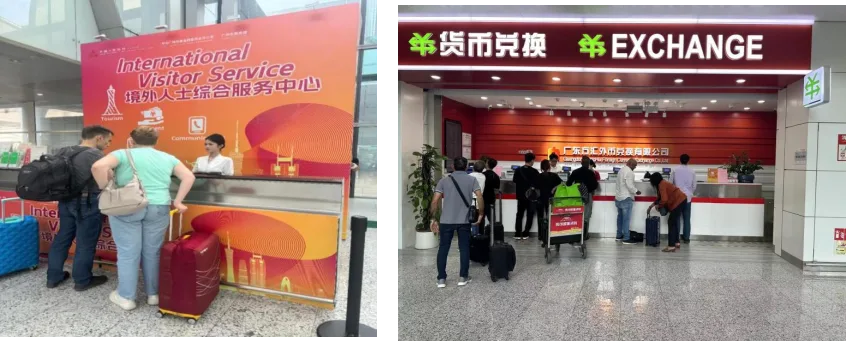
In T2's international arrivals area, near the exit, there's an international SIM card sales point and a Foreigner Comprehensive Service Center that opened ahead of the 2024 Canton Fair. It's staffed with multilingual help and handles three things travelers need at once: buying a SIM, linking a foreign bank card, and setting up Alipay or WeChat Pay. Best of all, it runs 24 hours — so even a red-eye arrival can get connected. Don't fixate on a specific counter or gate number you read online; those move. Land in T2, head for international arrivals, and look for the SIM/foreigner-services desk near the exit, or ask at the information counter.
Getting around China without Chinese?
Save routes and key phrases offline — show your driver the address in Chinese with one tap.
What you need to buy one
Your passport. Real-name registration is the law for every SIM in China — no passport, no SIM.
Your face. Activation includes a live facial-recognition check that matches you against your passport photo. It takes a few seconds.
Cash in RMB. Not every kiosk takes foreign cards, so bring some yuan to be safe.
Expect a limit of around three SIMs per passport. That's the figure travelers consistently report; treat it as a practical cap rather than something to test.
Which carrier to pick
Three national operators sell at the airport: China Mobile (中国移动), China Unicom (中国联通), and China Telecom (中国电信). For most foreign phones, China Unicom is the safe default — it has the broadest compatibility with overseas handsets and solid coverage in cities. China Mobile has the widest reach overall, but historically gave some foreign phones trouble; that matters less on modern 4G/5G but Unicom is still the easier bet.
Prices — expect ranges, confirm at the counter
Tourist plans shift by operator, promotion, and month, so treat these as ballpark and check the live price at the desk:
Plan type | Rough price | Data / validity |
|---|---|---|
Short tourist SIM (Unicom) | ¥58–¥100 | a few GB, ~7 days |
Monthly tourist plan (Unicom) | ¥200–¥268 | ~20 GB, 30 days |
Daily plan (China Mobile) | ~¥18 | 1 GB per day |
30-day data (China Telecom) | ~¥98 | ~20 GB |
Airport counters typically run a bit pricier than carrier shops in the city, so if you're staying a while and can wait, a downtown store may save you money.
One product worth asking about: China Unicom's CUBe Card, launched in early 2025. It bundles a SIM with digital-yuan payment and transit (metro, bus) on a single card, and it's pitched squarely at foreign visitors, including a short 10-day version built around the 240-hour transit window. The exact price wasn't published, so ask the counter what each tier costs.
The step-by-step at the counter
After collecting your bags in T2 international arrivals, find the SIM sales point or Foreigner Service Center near the exit (ask at information if you don't see it).
Say you want a short-term tourist SIM and roughly how many days you'll be in China; ask to see China Unicom's options.
Hand over your passport — the staff scan it and register your details.
Look into the camera for the facial-recognition check.
Pay, ideally in RMB cash.
The staff insert and activate the SIM in about 5 to 15 minutes. Confirm you have working data before you walk away.
The catch: a China SIM is censored
This is the part that surprises people. A SIM or data plan from a mainland carrier routes through the Great Firewall, so out of the box you won't be able to open Google, Gmail, WhatsApp, Instagram, Facebook, or Google Maps. If you go with a local SIM, you need a VPN installed before you arrive — you generally can't download a working one once you're already inside China.
If avoiding the firewall matters more than cheap local minutes, you have two cleaner options:
An international eSIM bought before you fly. Providers like the ones in our China eSIM guide route your traffic through gateways outside the mainland, so they sidestep the firewall with no separate VPN needed. The catch: you generally can't install or activate a non-Chinese eSIM once you're already in China, so set it up at home.
A Hong Kong SIM, used in roaming. Roaming on a Hong Kong SIM inside the mainland usually delivers uncensored data because your traffic exits via Hong Kong. Speeds can vary, but it's a simple way to skip both the firewall and the VPN.
In short: a local Guangzhou SIM is cheapest for local calls and data but needs a VPN; an international eSIM or Hong Kong SIM costs a bit more but gets you the open internet straight away. Whichever you choose, sort the firewall question before you land, not after. Once you're connected, our Guangzhou airport-to-city guide covers getting downtown.
Frequently asked questions
Can foreigners buy a SIM at Guangzhou airport? Yes. The Terminal 2 international arrivals area has a SIM sales point and a Foreigner Service Center set up for exactly this — bring your passport and you can buy and activate one on the spot.
Which terminal at Guangzhou Baiyun has the SIM counters? Terminal 2. International flights arrive at T2 (T1 is domestic only), and the foreigner-facing SIM and services desks are in T2's international arrivals near the exit.
Is the counter open late at night? The T2 Foreigner Service Center runs 24 hours, so a late or early arrival can still get a SIM. Individual operator kiosks may keep shorter hours, but the service center covers you.
Will a Chinese SIM let me use Google and WhatsApp? Not on its own — a mainland SIM is behind the Great Firewall. You'll need a VPN installed before arrival, or use an international eSIM or Hong Kong SIM that bypasses the censorship.
What do I need to bring? Your passport (mandatory for real-name registration), your face for the verification check, and some RMB cash, since not all counters take foreign cards.
Tags
Getting around China without Chinese?
Save routes and key phrases offline — show your driver the address in Chinese with one tap.