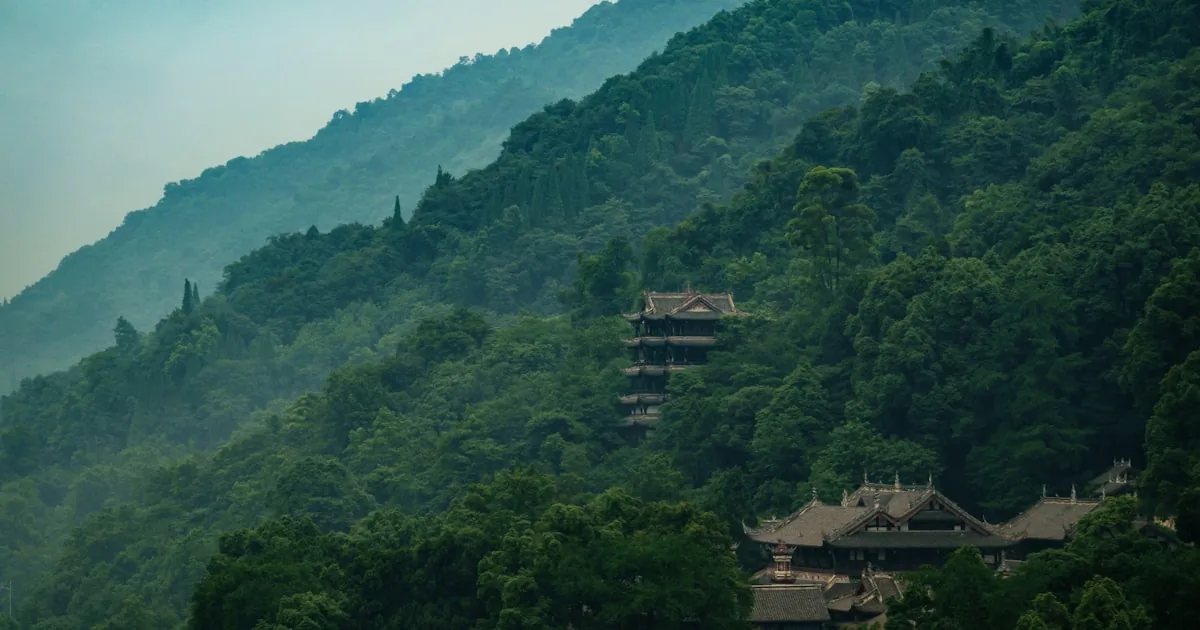
Hua Shan Mountain Guide: Xi'an Day Trip and Plank Walk
Quick answer: Hua Shan is a 40-minute high-speed train ride east of Xi'an, doable as a day trip. In 2026, entry is 160 RMB in peak season (Mar–Nov) or 100 RMB off-season, plus separate cable cars and shuttle buses. The Plank Walk in the Sky on South Peak costs 30 RMB, needs an advance reservation, and bans solo walkers.
Hua Shan is the one Chinese mountain that genuinely scares people, and it is close enough to Xi'an that you can stand on its West Peak before lunch. The mountain has five granite peaks, two cable cars, one legendary plank walk bolted to a cliff at 2100 meters, and a train schedule that makes a same-day trip entirely possible if you start by 7 a.m. This 2026 guide covers every piece you need: the ¥54-65 HSR ticket from Xi'an, the ¥100 park entry, the ¥80 and ¥140 cable cars, and whether you should push for sunrise or keep your feet on the ground.
What this guide covers
Hua Shan's five peaks and which one to prioritize
Getting there from Xi'an by HSR in 30 minutes (¥54-65)
Park entry, cable cars, and shuttle bus pricing for 2026
The Plank Walk in the Sky: how it works, ¥30 harness fee, waiting times
Day trip vs overnight: realistic time budgets
Sunrise strategy and where to sleep on the mountain
Weather, clothing, and what to bring
FAQs on safety, crowds, and altitude
Heading to China soon?
Take every guide offline — translation, payments, maps, and emergency help in one free app.
The Five Peaks and Which One to Climb
Hua Shan is shaped like a starfish. A central ridge connects five named peaks, each with a distinct personality. You will not summit all five in a day unless you cable car up and move fast.
West Peak (Lianhua, 2082m)
Most visitors start here because the West Peak Cable Car is the longest in Asia and delivers you near the summit in one ride. Lotus-shaped rocks, dramatic cliff views, and the classic Hua Shan skyline photo. This is also the fastest way to reach the Plank Walk.
South Peak (Luoyan, 2154m)
The highest point on the mountain and the launch point for the Plank Walk in the Sky. South Peak is also where the "Chess Pavilion" trail begins, a secondary suicide-scary walk that most sane visitors skip.
East Peak (Chaoyang, 2096m)
The sunrise peak. If you are coming for sunrise, this is where you aim. A stone platform on the east edge of the summit catches first light over the Wei River plain.
North Peak (Yuntai, 1614m)
Lowest of the five and home to the shorter, cheaper cable car. North Peak is where most day-hikers who want to walk up actually start, since the trail from the base to North Peak is the traditional pilgrim route.
Center Peak (Yuxuan, 2037m)
A smaller summit between East and South, with a temple and the famous "ginger tree" lookout. Often visited as a 15-minute side trip when moving from West to East.
Getting from Xi'an to Hua Shan
Hua Shan is 120 km east of Xi'an and has its own dedicated high-speed rail station. For 2026, the HSR is the only option that makes sense.
HSR: Xi'an to Huashan Bei Station
Trains depart Xi'an North (Xi'an Bei) station throughout the day, with the first around 07:00 and frequent service until late evening. The ride is 28-35 minutes depending on the train. Second-class tickets run ¥54-65, first class ¥85-95. Book on the 12306 app (now with full English), the official 12306 website, or Trip.com in English. Passport-based booking works and you collect tickets at any station window or scan your passport at the turnstile directly.
Get off at Huashan Bei (Huashan North) station. Do not confuse this with Huashan station, which is the old slower line and adds an hour.
Huashan Bei to the Visitor Center
From the HSR station you need to reach the Hua Shan Visitor Center (Youke Zhongxin), 5 km south. Options:
Free shuttle bus: Departs the station to the visitor center every 15-20 minutes, 7 a.m. to 6 p.m. This is the default choice.
Didi: ¥15-25, about 10 minutes. Useful if you arrive outside shuttle hours.
Taxi: ¥20-30, same ride, less predictable metering.
Driving and Tour Buses
Private cars and Didi can take you all the way to the visitor center; there is paid parking for ¥20-40 per day. Tour buses from Xi'an hotels exist but trade flexibility for a 1-hour pickup and drop rhythm that kills your summit time.
As of January 14, 2026, a free shuttle runs directly between Huashan North high-speed-rail station and the scenic-area visitor center, 8:00 to 18:00, with no intermediate stops; you scan your scenic-area ticket QR code to board. If it is not running or you arrive outside those hours, the standard fallback is the public bus, which leaves about every 10 minutes from 6:30 to 20:00, costs 3 RMB by QR payment, and takes roughly 30 minutes. One thing to confirm in advance: the eco-plaza visitor center (start of the cable-car routes) and the Yuquan Yuan trailhead (start of the foot climb) are two different drop-off points, so board the right service for your plan.
2026 Entry, Cable Cars, and Shuttles
Hua Shan's pricing changes by season. Every foreign visitor needs an entry ticket plus transport on and off the mountain.
Park Entry Ticket
March 1 to November 30 (peak): ¥100
December 1 to February 28 (low): ¥50
Children under 1.2m and seniors over 65 with ID: discounted or free
Buy on the 12306 sister app, the Hua Shan official WeChat mini-program, Trip.com, or directly at the visitor center ticket hall. Passport scan required at the gate. Tickets are same-day use.
Shuttle Bus from Visitor Center to Cable Car Bases
You cannot walk from the visitor center to the cable car stations directly; a shuttle bus is mandatory.
West Peak Cable Car shuttle: ¥40 one way, ¥80 round trip, 30 minutes
North Peak Cable Car shuttle (Zhiguan village): ¥20 one way, ¥40 round trip, 20 minutes
Cable Cars
West Peak Cable Car (Taihua): ¥140 one way, ¥280 round trip. Longest in Asia, 4211m horizontal, gorgeous views. This is the one most international travelers choose.
North Peak Cable Car (Sanyuan): ¥80 one way, ¥160 round trip. Shorter, cheaper, connects to the traditional trail system.
The Classic Route Combinations
Most visitors pick one of three itineraries:
Up West, down North: ¥140 + ¥80 + ¥120 shuttles = ¥340. The comfortable all-day loop covering all five peaks in 7-8 hours.
Up West, down West: ¥280 + ¥80 shuttles = ¥360. Fastest, around 5 hours on the mountain. Skip East Peak.
Up North, down North: ¥160 + ¥40 shuttles = ¥200. Cheapest cable option, 6-7 hours, good for focused West/North peak visits.
The entry price changes by season, which most guides skip. Peak season (March 1 to November 30) is 160 RMB full / 80 RMB concession; off-season (December 1 to February 28) drops to 100 RMB, and the deep-winter window (January 1 to February 28) is discounted further to 80 RMB. Tickets are real-name and must be reserved in advance against your passport. Foreign-passport holders should book the entry-plus-cable-car bundle on an international platform before arriving, because the official WeChat mini-program often rejects foreign cards and its English interface is unreliable; you then scan your physical passport at the electronic turnstile and skip the ticket-office lines.
Both cable cars close for annual maintenance in winter, and hitting a closed line is the single most common way travelers waste a trip. The West Peak (Taihua) cable car finished its 2025 annual overhaul and resumed service on December 14, 2025. The North Peak (San Te) cable car is scheduled to close for full maintenance from January 14 to January 22, 2026; during that window the hiking trail and the West Peak cable car keep running. Check the scenic area's official channel for the current year's dates before you commit to a route, especially if you travel in January.
The Plank Walk in the Sky
Changkong Zhandao, "Plank Walk in the Sky," is the reason many travelers come to Hua Shan at all. It is a 100-meter stretch of wooden planks and iron chains bolted to a vertical cliff face, about 30 minutes walk south of the South Peak summit.
How It Works in 2026
Approach the Changkong Zhandao entrance below South Peak.
Pay the ¥30 harness rental fee at the gate (cash, Alipay, or WeChat).
A staff member clips two carabiners onto a steel cable running along the cliff above the planks.
You walk out, reach the small shrine at the far end, turn around, and walk back along the same planks.
Total time on the walk: 20-40 minutes depending on queue.
Waiting Times and Best Hours
Peak season (April-October weekends) can see queues of 1-2 hours. Arrive before 09:00 or after 15:00. Off-season weekdays are usually under 20 minutes wait.
Safety Reality
The harness is real, the cables are maintained, and the last major incident was many years ago. Physical risk is low if you follow the staff. The psychological difficulty is the actual challenge: looking down at 1800 meters of open air under your boots can freeze beginners on the planks. Do not lock up; take slow steps, keep your weight forward, and talk to yourself out loud if it helps.
If You Skip the Plank Walk
Plenty of visitors take one look, decide no, and turn back. The views from South Peak itself are spectacular without the harness. No shame in that.
The reservation system has hard daily caps that explain the queues. The Plank Walk admits a maximum of 150 people per day, released in batches of 30, with each batch given a 1.5-to-2-hour window. Solo entry is forbidden by rule: you must go in a group of two or more before staff will fit you with a harness. Eligibility is age 15 to 55 and height 150 cm or taller, and anyone with heart disease, coronary conditions, high blood pressure, or a fear of heights is barred. The 30 RMB ticket includes the harness rental and is bought on-site rather than as a standard advance e-ticket.
You cannot carry a backpack onto the Plank Walk, so plan to stash it. There is a left-luggage point about 380 meters from the visitor center charging roughly 5 RMB per backpack per day and 10 RMB per suitcase per day; many people instead leave the bag with their travel partner at the South Peak top while they take turns on the planks. Once harnessed, you clip your own two safety carabiners onto the steel rebar set into the cliff and slide them along as you move; staff demonstrate but do not clip for you.
The Plank Walk is a dead end, not a loop. It runs about 50 meters down the South Peak cliff in three sections, the lower one being the most exposed, where you press your chest to the rock and shuffle sideways. Because there is no exit at the far end, everyone returns along the exact same planks, so the genuinely nerve-wracking moment is the 'passing dance' where outbound and returning walkers squeeze past each other over the drop. A cliffside photographer will shoot you for about 60 RMB per photo if you would rather not bring out your own phone.
If the Plank Walk is sold out or you would rather not commit to it, the nearby Yaozi Fanshen (Sparrowhawk Turn-Over) on East Peak is the usual alternative. It uses the same 30 RMB harness rental and the same self-clip safety system, but most visitors rate it as a notch less terrifying than the Plank Walk; it can be a good warm-up or a substitute when the Plank Walk's 150-person daily quota fills.
Day Trip vs Overnight: The Time Budget
A day trip from Xi'an is viable if you commit to an early start. An overnight on the mountain is the only way to reasonably watch sunrise.
Day Trip (Recommended Starting Point)
06:30: Taxi or metro Line 2 to Xi'an North Station
07:00-07:30: Earliest HSR, arrive Huashan Bei 07:30-08:00
08:00-08:45: Shuttle and entry, reach West Peak Cable Car base
09:00-09:30: Ride up to West Peak
09:30-14:00: West to South Peak, Plank Walk, East Peak traverse
14:00-15:00: Descend via North Peak cable car and shuttle
15:30-16:30: Return shuttle to HSR station
16:30-18:00: HSR back to Xi'an, dinner in the Muslim Quarter
Tight but doable. Allow buffer for Plank Walk queues.
Overnight (Sunrise Strategy)
Sleeping on Hua Shan is expensive and basic. Mountain hostels near East Peak charge ¥400-800 per bed in 2026, dormitory style, thin mattresses, shared toilets, no showers. They exist for one reason: positioning you for sunrise.
Day 1 afternoon: HSR from Xi'an, reach West Peak by 15:00, traverse to East Peak by 18:00.
Night: Mountain hostel near East Peak.
Day 2: 04:30 wake, 05:00 on the sunrise platform, 06:00 sunrise, 06:30 breakfast, then descend via North Peak or West Peak cable car.
HSR back to Xi'an by 11:00.
Avoid: Overnight Climb on Foot
The old "climb overnight on foot" route up the soldier's path is still open but brutal: 6-8 hours of relentless stairs in the dark. Only attempt if you are genuinely fit, have a headlamp, and speak enough Chinese to ask for help if something goes wrong. For most travelers this is unnecessary suffering.
Weather, What to Wear, and What to Bring
Hua Shan's weather changes fast. At 2100m, temperatures run 10-15 C colder than Xi'an, and summit wind can be punishing.
Seasonal Temperature Notes
Season | Xi'an high | Summit high | Notes |
|---|---|---|---|
Spring (Mar-May) | 15-25 C | 5-15 C | Windy, occasional rain, pleasant |
Summer (Jun-Aug) | 28-35 C | 18-25 C | Warm but storms common, start early |
Autumn (Sep-Nov) | 15-25 C | 5-15 C | Clearest views, best season |
Winter (Dec-Feb) | 0-10 C | -10 to 0 C | Ice on chains, some paths closed |
Packing List
Grippy hiking shoes or trail runners (no sandals, no leather dress shoes)
Light windbreaker and fleece layer year-round
1.5L water minimum; refill stations exist but lines are long
Snacks (mountain vendors charge ¥15-30 per bowl of noodles and ¥10 for a bottled water)
Small cash plus Alipay/WeChat; upper mountain vendors prefer mobile pay but cash works
Phone with Amap downloaded offline; cell signal is patchy on the ridge
Power bank; cold and sustained use drain batteries fast
FAQ
How long does it take to visit Hua Shan as a day trip from Xi'an?
A realistic day trip is 11-13 hours door to door. Early HSR from Xi'an North at 07:00, arrive Huashan Bei by 07:35, on the West Peak Cable Car by 09:00, six hours on the mountain, back at Xi'an North by 18:00 or 19:00. Anything faster means skipping peaks or rushing the Plank Walk queue.
Is the Plank Walk in the Sky safe?
Yes, in the sense that you are clipped to a steel cable with double carabiners and the infrastructure is inspected. The risk is psychological: freezing up on the planks. Stay low, move slowly, do not look straight down, and let the harness do the work. Children under 120 cm, people with cardiac issues, and anyone who cannot handle verticality should skip it.
Can I climb Hua Shan without a guide?
Yes. Hua Shan does not require a guide. Signage is in Chinese and English, the path system is well-marked, and staff at cable car stations speak some English. Solo international visitors hike Hua Shan every day without a guide. A guide only helps if you want translation during a sunrise trip or historical context on the Taoist temples.
What is the cheapest way to do Hua Shan from Xi'an in 2026?
HSR second-class round trip ¥108-130, entry ¥100 peak or ¥50 low season, shuttle to North Peak cable car ¥40 round trip, North Peak cable car round trip ¥160, and basic food ¥50. That lands around ¥450-480 per person in peak season without the Plank Walk, or ¥400 in low season. Walking the full route up and down the soldier's path saves the cable car cost but demands 10-12 hours of stairs.
When is the best time of year to visit Hua Shan?
Late September through early November is the best window: clear skies, stable weather, cool but not cold, and autumn colors on the lower slopes. Avoid May 1-5 and October 1-7 (Golden Week) when Chinese domestic tourism overwhelms every cable car queue. Winter is dramatic but many trails close and chains freeze.
Do I need any permits or registrations for Hua Shan?
No special permits. Your passport plus the park entry ticket is enough to pass every gate in 2026. The park ticket is purchased against your passport number and scanned at the entry turnstile. Children under 1.2 meters enter free and do not need a ticket. Hikers planning to overnight on the mountain do not need to register in advance, but the mountain hostels do require passport details on check-in.
Is there food and water on Hua Shan?
Yes, at inflated prices. Small vendor stalls near the cable car stations and along the ridge sell instant noodles for ¥20-35, bottled water for ¥10, sausages and boiled eggs for ¥15-25, and basic rice dishes at the mountain hostels for ¥40-60. Cash and Alipay or WeChat Pay both work at most stands. Bring your own snacks from Xi'an if you want to save money or keep dietary options open; the ridge has limited vegetarian choices.
Can I leave luggage at Huashan Bei station or the visitor center?
Yes. Huashan Bei station has paid luggage lockers near the exit, ¥15-30 per 4 hours depending on size, accepting Alipay and WeChat Pay. The Hua Shan visitor center also offers a staffed bag drop for ¥20-50 per item per day. Day-trippers from Xi'an typically leave large bags at their Xi'an hotel instead and carry a small day pack up the mountain.
Tags
Heading to China soon?
Take every guide offline — translation, payments, maps, and emergency help in one free app.